

A customer can love a product, praise the company and still leave.
Not because a competitor offered a better deal. Not because the product failed. Not because the relationship deteriorated.
The customer can simply stop needing it.
SaaStr founder Jason Lemkin recently described this happening inside his own company. SaaStr had used Notion heavily for years. Then its internal AI agents absorbed the meeting notes, project trackers, dashboards and other workflows that had lived there. The company did not run an evaluation or announce a migration. According to Lemkin's account, the team eventually realized it had not opened Notion in months even though the subscription remained active.
The same agents produced the opposite result for Salesforce. SaaStr says it reduced its human Salesforce users by 80 percent while its agents used the system far more heavily, contributing to an increase in annual spend from about $12,000 to $22,000. Those figures are one company's self-report, not a market forecast. But the contrast reveals a mechanism that conventional SaaS metrics struggle to see.
In one product, the agents became customers.
In the other, they made the customer disappear.
Financial Churn Is the Last Step
Software companies usually recognize churn when revenue goes away.
A contract is not renewed. Seats are removed. A customer downgrades. Annual recurring revenue falls. Net revenue retention records the result.
By that point, the important event may be months old.
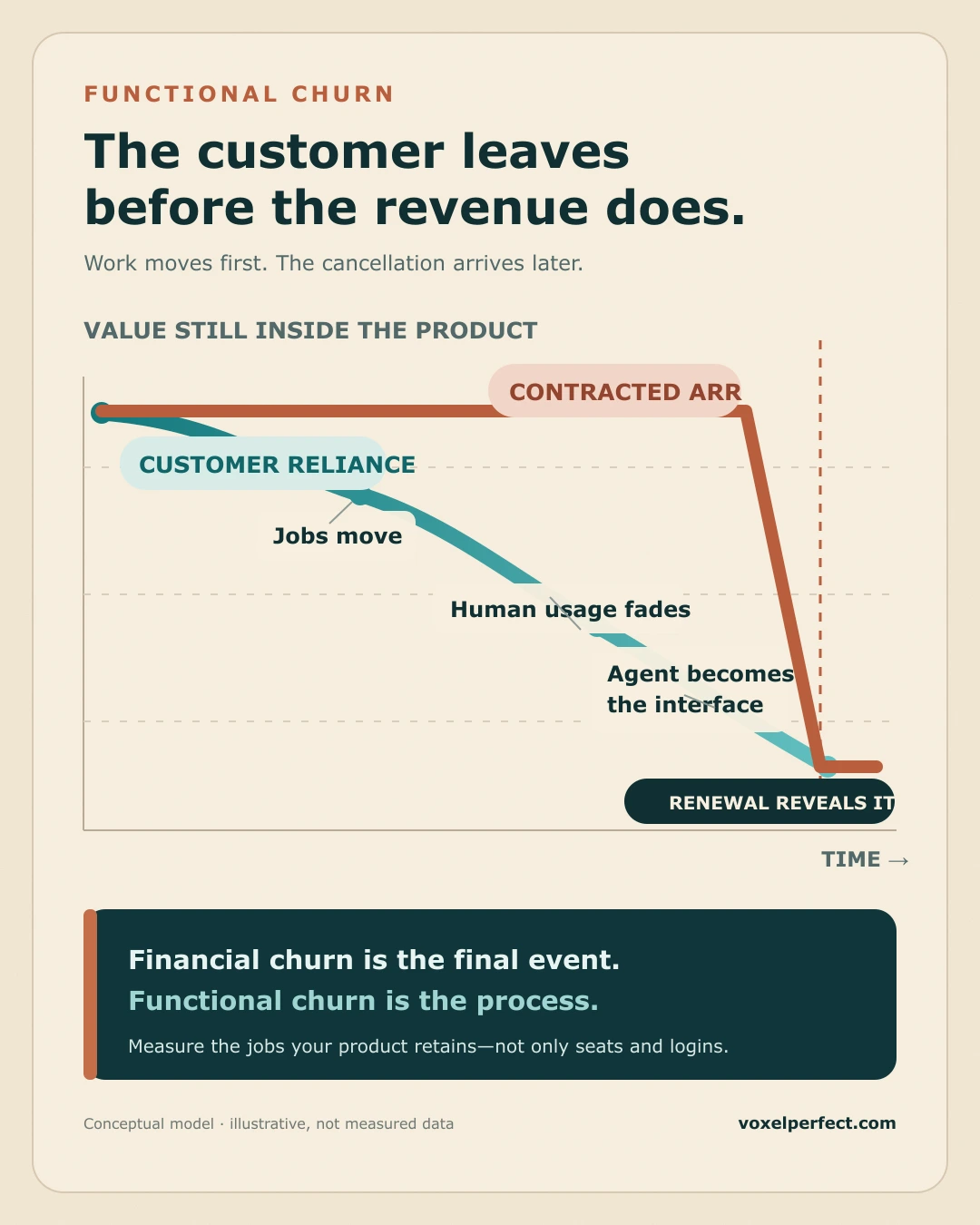
The customer began leaving when the product lost its first meaningful job. Another workflow moved later. Human usage declined, but the account still looked calm. There were no angry support tickets, no procurement notice and no competitor in the CRM. The invoice kept being paid.
Call this functional churn: the transfer of work away from a product before the commercial relationship changes.
Functional churn is not entirely new. Companies have paid for shelfware for as long as software has been sold. Champions leave, projects end and purchased seats go unused.
AI changes the substitute and the speed.
An internal agent can take over a narrow job without asking the company to replace the whole application. It can pull information from several systems, assemble a purpose-built interface and write results back into the tools that remain authoritative. The transition can happen workflow by workflow, often without a formal software-buying event.
SaaStr describes its 10K system as a dashboard, a database and scheduled jobs connected to Bizzabo, Salesforce, Marketo, WordPress, X, YouTube, Slack and Resend. It says the system was assembled with about six weeks of code and operates at a marginal cost of roughly $30 to $60 per month. Again, this is an unusually AI-forward company reporting its own results. The case matters not because every customer will reproduce it, but because it demonstrates that substitution no longer needs to arrive in the form vendors are organized to observe.
The competitor may never create an opportunity record because the competitor is a workflow the customer assembled.
Brand Pays at the Moment of Choice
The State of Brand's analysis of the SaaStr case identifies the brand problem precisely: preference can influence a decision only when someone has to decide.
Traditional competitive displacement creates such a moment. A buyer compares vendors, asks colleagues, reads reviews, evaluates risk and chooses. Brand can reduce uncertainty, earn inclusion on the shortlist and justify a premium. Even when products look similar, trust and familiarity can determine who wins.
Functional churn can remove that moment.
No one at SaaStr had to decide that Notion was bad. The product could remain well designed, respected and liked. Its jobs moved elsewhere anyway. Affection survived longer than operational necessity.
This creates an uncomfortable limit for software brand strategy.
A brand can make a customer prefer the product. It cannot preserve a workflow that no longer passes through it.
That does not mean brand becomes worthless. It means its value depends on where the product sits in the new operating system.
Three Kinds of Software Brand Value
The agent era separates software brand value into three layers.
Preference
This is the familiar layer: recognition, affinity, reputation and the expectation of a good experience. It helps a product enter consideration and win when people compare options.
Preference is powerful at acquisition. It can also support expansion and forgiveness when something goes wrong.
But it is weakest against silent absorption because no new vendor needs to win the customer's affection.
Permission
Enterprise software is not adopted only because users like it. Security, legal, finance, IT and procurement must be willing to let it into the organization.
At this layer, brand means confidence that the vendor will protect data, honor contracts, remain available, meet regulatory obligations and respond when the system fails. Agents make this permission layer more important because they can read across systems and act with delegated authority.
A trusted name can shorten the path to approval. Yet approval alone does not guarantee that work will continue to flow through the product.
Dependency
The strongest layer is operational dependency.
The system holds authoritative state. Other systems query it. Agents need its records, permissions, history or action surfaces to complete their work. Removing it would break a process rather than merely inconvenience a user.
This is why the SaaStr comparison between Salesforce and Notion is useful despite its limitations. SaaStr says its agents depend on Salesforce for contacts, pipeline and activity history, while they routed around the workflows that previously made Notion a daily destination. One product became infrastructure for the agents. The other remained a product the humans remembered fondly.
The distinction is not between old and new software. It is between being a destination and being a dependency.
The Airtable Deal Was the Macro Version
The acquisition of Airtable by Bending Spoons showed the same transition at company scale.
In my analysis of the transaction, I argued that traditional SaaS is being squeezed from two directions. AI-first entrants weaken the assumption that reusable applications and human seats are the natural units of value. AI-native operators use automation and shared platforms to run established software assets with a different cost structure.
The State of Brand reached the deal from another direction, arguing that Airtable's name, customer habit and switching costs were among the assets that retained value after its venture-growth story was repriced.
Both views can be true, but the SaaStr case adds an important condition.
Habit and switching costs retain value only while meaningful work continues to pass through the product. Agents can reduce both gradually. They do not need to migrate the entire organization in one program. They can absorb a report, a tracker, a review process or an internal interface one at a time.
This is how a strong software brand can remain recognizable while its economic foundation becomes thinner.
The company does not lose the category in one dramatic event.
It loses jobs inside customer accounts.
The Interface Is Not the Relationship
The first response to declining human usage is often to improve the interface or add AI inside the existing product.
That may work. Notion is not standing still. Its official MCP service lets external AI tools read and write Notion workspaces, and its July 2026 release added external agents and reported that Notion MCP usage had increased tenfold in the preceding month. The company is explicitly trying to become a place where both people and external agents can work.
That response illustrates the larger strategic move.
The durable relationship is not necessarily the human opening the application. It is the product remaining inside the execution path.
An agent may become the primary interface while the SaaS product continues to supply governed data, collaboration state, permissions and actions. In that case, falling human logins do not necessarily signal decay. They may accompany higher machine activity and greater operational value.
This makes the old dashboard ambiguous.
- Declining human activity can mean the customer is leaving.
- It can also mean the customer's agents are using the product successfully on people's behalf.
- Stable revenue can conceal either condition until the contract is reconsidered.
The vendor must know which path each account is taking.
Retention Needs a New Leading Indicator
Seats, logins, support tickets, NPS and renewal dates still matter. None of them directly measures whether the product is retaining its jobs.
A more useful retention model would include at least five signals.
Job breadth
How many distinct, meaningful jobs does the customer rely on the product to perform?
An account using one feature frequently may be more fragile than an account using four interconnected workflows less visibly. Frequency measures activity. Job breadth measures how many reasons the customer has to remain.
Dependency depth
What breaks if the product disappears?
A tool that presents a copy of information held elsewhere is easier to route around than one that owns authoritative state, permissions or irreversible actions. Dependency depth should distinguish convenience from operational necessity.
Human and agent activity
Machine-mediated usage needs to be visible as its own category.
If human activity falls while permissioned API calls, agent actions and governed writes rise, the product may be moving deeper into the stack. If both human and agent activity decline, functional churn may already be under way.
Workflow loss
Customer-success teams should record when a report, process, integration or department leaves the product even if the contract remains intact.
The loss of a workflow is not a minor adoption issue. It is partial churn.
Replacement time
How quickly could a competent customer recreate the remaining value with an internal agent, a model and access to existing systems?
This is not a request for false precision. The exercise forces the vendor to identify which value comes from durable assets and which comes from an interface over information the customer already owns.
Together, these signals describe workflow retention: the share of the customer's important work for which the product remains necessary.
Financial retention reports what the customer has already done contractually. Workflow retention estimates what the customer is becoming operationally.
Pricing Must Follow the New Customer
The seat is a poor unit when fewer humans can produce more work through agents.
The SaaStr example makes the inversion vivid: fewer human Salesforce users, but reportedly much more activity and higher spend. Salesforce can capture some of that value because it meters agent actions and offers consumption-based pricing. Its current Agentforce pricing includes Flex Credits consumed by actions such as updating records or executing prompts, alongside user licenses and conversation pricing.
That model is not automatically fair or simple. Consumption bills can become unpredictable, and an action is not the same thing as a business outcome. But it gives revenue somewhere to move when successful automation reduces seats.
A vendor that remains essential to agents while charging only for humans creates its own monetization problem.
A vendor that remains tied to human seats while agents route around it has a deeper product problem.
The pricing transition cannot rescue software that has lost its jobs. It can let software that retains those jobs participate in the value agents create.
Brand Has to Become Executable
The old software-brand promise was often experiential:
This is the application your team will prefer to use.
The agent-era promise must also be operational:
This is the system your organization can trust people and agents to depend on.
That promise has product requirements.
The system needs clean APIs and agent interfaces. It needs stable schemas, scoped permissions, audit trails, reliable exports, service guarantees and action boundaries that security teams can understand. It needs pricing that remains coherent when software performs more work for fewer people. It needs customer-success teams able to see workflows moving before the cancellation arrives.
Brand still matters throughout this transition. Buyers must trust the company enough to connect sensitive data and delegate actions. Employees must believe the system will behave predictably. Executives must believe the vendor will remain accountable when automation fails.
But brand can no longer be separated from operational position.
The most valuable software brand will not simply be the name people remember when selecting an application. It will be the name an organization trusts inside the path from intention to action.
The Customer Leaves Before the Revenue Does
The Airtable transaction showed what happens when the market reprices a software company's growth story.
Functional churn explains one way that repricing can accumulate before it becomes visible.
Work moves first. Human habits weaken next. An agent becomes the new interface. The subscription survives until someone finally examines the invoice.
At the end, the cancellation looks sudden.
It is not.
The customer has been leaving one job at a time.
The strategic task for a SaaS company is therefore larger than preventing churn or adding an AI assistant. It must discover whether its product remains a destination, becomes a dependency or quietly turns into neither.
Brand can help a company be chosen.
In the agent era, the harder objective is to remain necessary after the moment of choice disappears.
Sources
- Jason Lemkin's Salesforce and Notion comparison supplies SaaStr's self-reported changes in human seats, agent activity, spend and Notion usage. His earlier description of 10K documents its components, integrations, development time, tasks and estimated marginal cost. These are an illustrative company case, not independent market-wide evidence.
- The State of Brand's quiet-churn analysis develops the implications of the SaaStr cancellation for retention and brand, while its Airtable analysis frames the acquisition as a test of the value remaining in Airtable's name, installed behavior and switching costs.
- Notion's official MCP documentation explains how external agents can read and write workspaces. Its July 2026 release introduces external agents and reports tenfold monthly growth in Notion MCP usage.
- Salesforce's official Agentforce pricing and Flex Credits announcement document its mix of action-, conversation- and user-based pricing. They support the pricing-mechanism analysis, not SaaStr's self-reported account figures.