

On August 4, 2026, Bending Spoons agreed to buy Airtable.
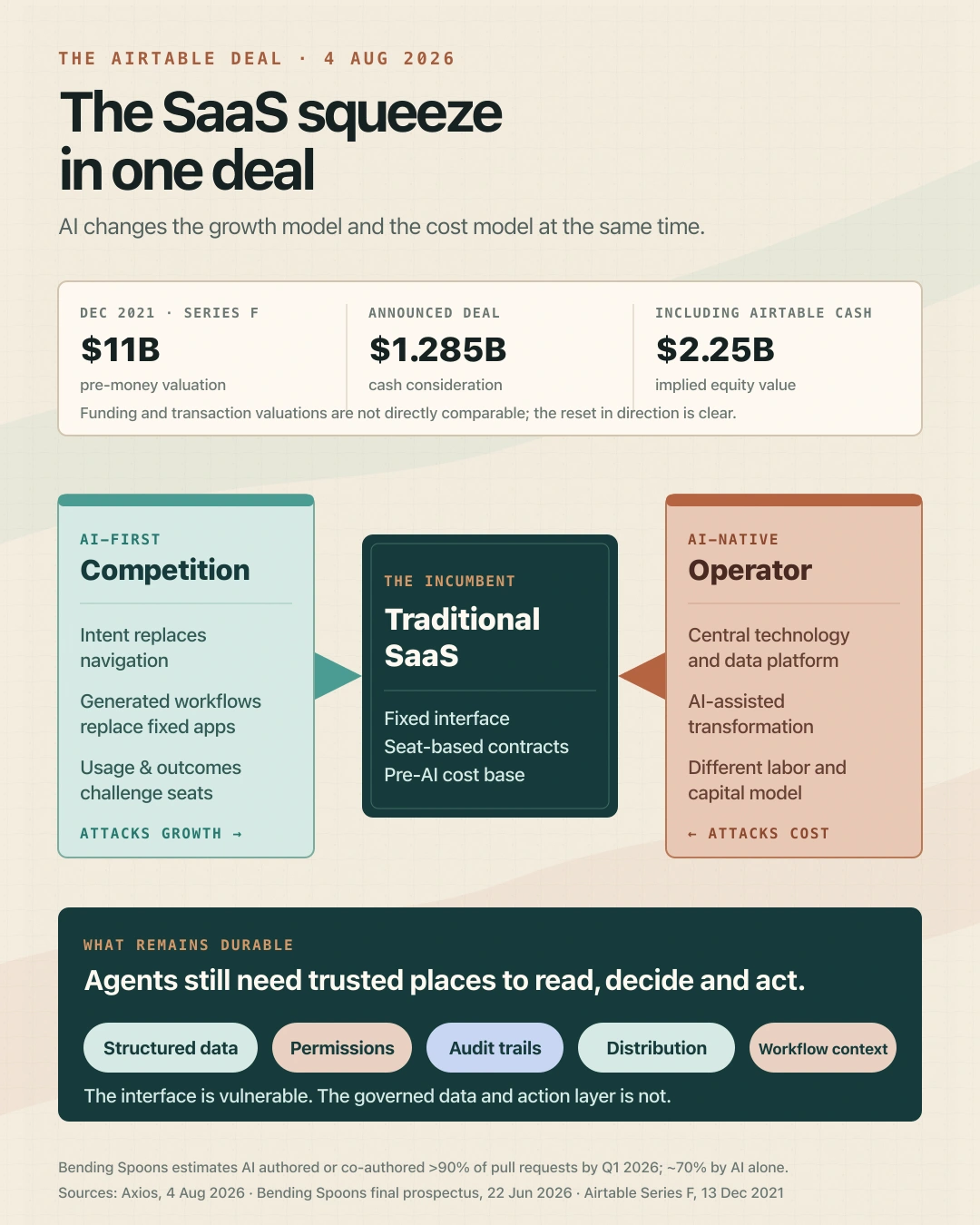
The numbers make the transaction feel like an obituary for traditional software. Axios reported a $1.285 billion cash purchase price and an implied equity value of $2.25 billion including Airtable's cash and cash equivalents. In December 2021, Airtable had raised $735 million at an $11 billion pre-money valuation, bringing its total funding to $1.36 billion.
Those are not perfectly comparable figures. A private financing valuation and the economics of an acquisition measure different things, and the reported purchase price must be distinguished from the implied value including cash. But the direction is unmistakable: one of the defining SaaS companies of the previous cycle is being acquired at a fraction of its peak valuation.
The easy explanation is that AI killed Airtable.
The facts support a more useful one.
Airtable did not ignore AI. It introduced Airtable AI in 2023, launched Cobuilder in 2024, and in June 2025 declared an “AI-native” refounding around Omni, field agents, conversational app creation, and agentic workflows.
The Airtable deal therefore exposes a harder problem than failing to add the right feature.
AI is changing the economic architecture of software faster than established SaaS companies can change the operating systems built around their products.
The SaaS Squeeze
Giampiero Marinò's analysis of Bending Spoons captures one side of the transaction well. Bending Spoons is not simply a portfolio of apps. It is a centralized acquisition and transformation machine: buy established digital businesses, connect them to shared technology and data, change their cost and monetization structures, and recycle the resulting cash into the next acquisition.
The Airtable deal reveals a second side.
Traditional SaaS is being squeezed from both directions:
- AI-first entrants attack the growth model. They generate software on demand, let agents execute work across systems, and increasingly price usage or completed outcomes instead of access to a fixed application.
- AI-native operators attack the cost model. They use shared platforms, centralized expertise, automation, and AI-assisted engineering to run established software assets with radically different labor and capital requirements.
The incumbent sits in the middle with a difficult inheritance: a fixed product surface, a large organization, seat-based contracts, enterprise sales and implementation machinery, and a valuation that assumed years of compounding subscription growth.
AI does not need to make the incumbent's product useless.
It only needs to make its growth slower and its cost structure look too heavy at the same time.
Airtable Was Built for the Previous Scarcity
The classic SaaS model was designed around scarce software.
A vendor spent years building a broad application. Customers selected from the available products, paid for users to access one, configured it to approximate their workflow, and hired administrators or consultants to keep it useful. The vendor expanded by adding features, editions, seats, modules, sales capacity, customer success, and integrations.
Airtable was one of the most imaginative expressions of that model. It did not force every customer into the same workflow. It provided flexible primitives—tables, views, interfaces, automations, and permissions—so teams could build their own applications without conventional software development.
That flexibility was a major advantage when custom software was expensive.
AI changes the comparison. The customer is no longer choosing only between buying a standard application and commissioning a costly internal build. A third option is becoming credible: describe the required workflow and let an agent generate, modify, and operate much of the software.
Replit Agent, for example, takes an application from a natural-language description to deployment. Lovable says builders created enough demand for the company to reach $200 million in annual recurring revenue in its first year. These companies are not drop-in replacements for Airtable's governance, permissions, or enterprise reliability. They do, however, change the customer's reference price for creating a tailored application.
What used to require selecting and configuring a platform can increasingly begin with an instruction.
That weakens one of SaaS's foundational assumptions: that the reusable application is the scarce asset.
The Seat Is No Longer the Natural Unit
The product model is changing with the interface.
A traditional SaaS application sells access. More users usually mean more seats, and more seats mean more revenue. Airtable's current pricing still charges paid plans per user with edit permissions. Its AI layer has evolved toward pooled credits, but the monthly allowance is still generally calculated from the number of paid collaborators, according to Airtable's AI billing documentation.
An agent changes the unit of value. If software completes work that a human previously performed inside an application, the customer may have fewer human users precisely when the software becomes more useful.
AI-first companies are testing commercial models that reflect that inversion. Sierra describes its pricing in terms of completed customer-service outcomes. Intercom's Fin charges $0.99 for a resolution, after included usage, rather than treating the AI only as another human seat.
Outcome pricing is not automatically superior. Outcomes can be difficult to define, attribute, audit, and price. Usage pricing can also make bills less predictable, while model inference introduces a variable cost that conventional SaaS worked hard to minimize.
But the strategic change is real.
The vendor is moving from selling a place where work happens to accepting responsibility for some of the work.
That is not a feature upgrade. It changes product design, measurement, gross-margin management, sales incentives, implementation, support, and the contract itself.
Airtable Added AI. Its Business Still Had to Cross the Gap
Airtable understood much of the product transition.
Its 2025 refounding described the existing platform as a “parts bin” that Omni could use to create reliable apps. The idea was strong: combine conversational generation with structured data, visible logic, enterprise permissions, and proven application components. Airtable also made app building with Omni free while charging credits for AI actions such as analysis, research, and document processing.
This is meaningfully more ambitious than attaching a chat box to a mature interface.
It also demonstrates why the transition is so difficult. A company can redesign the experience faster than it can redesign everything around the experience.
Airtable had already been restructuring before the generative-AI product wave. In a September 2023 message to employees, CEO Howie Liu said the company needed to become more efficient, mature in its execution, and orient itself around long-term financial success. That followed an earlier shift toward large enterprise customers and two major rounds of layoffs.
AI did not create all of Airtable's valuation reset. The company raised its largest round during the exuberant software market of 2021, built for aggressive growth, and then entered a more demanding capital environment. The acquisition should not be used to manufacture a single-cause story.
What AI did was raise the bar for the recovery.
Airtable no longer had to prove only that it could grow efficiently as an enterprise SaaS platform. It had to prove that the platform itself would remain the right abstraction when customers could generate applications and deploy agents elsewhere.
Bending Spoons Attacks the Other Side of the Income Statement
Bending Spoons is not the AI-first application startup in this story.
It is the AI-native operator.
Its IPO prospectus describes a repeatable playbook: acquire, transform and optimize, then reinvest. The company says it typically reimagines acquired businesses rather than limiting itself to superficial improvements. Product development, infrastructure, marketing, monetization, data, and organizational design become capabilities of the central platform rather than separate functions that every acquired company must reproduce.
AI increases the leverage of that model. Bending Spoons estimates that the share of software pull requests authored or co-authored by its internal AI systems rose from less than 10% in the first quarter of 2025 to more than 90% by the end of the first quarter of 2026, with about 70% authored by AI alone. It reports revenue per full-time-equivalent employee rising from $1.12 million in 2023 to $2.57 million in 2025, while explicitly identifying AI as one catalyst rather than the sole cause.
The prospectus then states the acquisition logic directly: AI may let the company do more with fewer people, improve the scalability of its transformation model, increase disruption risk for less-prepared software companies, and make some owners more willing to sell at lower valuations.
In other words, Bending Spoons expects AI to work twice:
- increase the supply of attractively priced software assets; and
- increase the number of those assets its central organization can transform.
This is why the acquisition is more revealing than another story about a down round. Airtable is moving from a venture-growth model, where organizational capacity was built to capture a vast future market, into an operating model that values predictability, installed users, brand, data, and cash-generation potential.
The asset did not become worthless.
The theory of how to extract value from it changed.
What AI-First Actually Means
“AI-first” is becoming as vague as “digital transformation.” The useful definition is economic, not cosmetic.
An AI-first company is not simply one that uses a model in its product. It is designed around capabilities and constraints that did not exist in the traditional SaaS model:
- Intent can replace navigation. The user describes a goal instead of learning every menu and configuration surface.
- The workflow can be generated. The product assembles or modifies software for the specific job instead of asking the customer to adapt to a fixed application.
- The system can perform work. Agents research, decide, create, update, and coordinate across tools rather than only present records to a human operator.
- The commercial unit can move toward usage or outcomes. Revenue can follow completed work instead of the number of people licensed to attempt it.
- The organization can operate at a different scale. AI is embedded in engineering, support, marketing, analytics, and implementation from the beginning, rather than introduced into a headcount structure designed around older productivity assumptions.
These choices create new risks. Generated software can be unreliable. Agents can take incorrect actions. Outcome pricing can hide ambiguous definitions. AI-heavy cost of revenue can surprise companies that mistake model usage for nearly free SaaS gross margin. Enterprise buyers still need permissions, auditability, data controls, service levels, and accountable humans.
That is where established SaaS retains real leverage.
Systems of Record Are Not Dead
AI agents need somewhere reliable to read and write state.
They need structured data, identity, permissions, audit logs, workflow history, and integration boundaries. Airtable has spent years building those assets and embedding them inside customer operations. Its product claims use across more than 500,000 organizations.
This is why “SaaS is dead” is the wrong conclusion.
The interface layer is vulnerable. The seat model is vulnerable. Feature scarcity is vulnerable. A cost base built for labor-intensive software production is vulnerable.
But trusted systems of record, proprietary workflow context, distribution, and permissioned action surfaces may become more valuable as agents proliferate.
The strategic question for an incumbent is whether it can expose those assets to agents without protecting the old interface, pricing model, and organization so aggressively that a new company captures the action layer first.
The Required Refounding Is Economic
Traditional SaaS companies do not need more AI announcements. They need to decide what business they would build if their current application, price metric, and staffing model did not already exist.
That requires at least five moves:
1. Choose a unit of value that survives fewer human users
If successful automation reduces seats, the vendor needs a credible way to participate in the value created without charging for vague activity or punishing adoption.
2. Treat the interface as replaceable
The durable asset should be the governed data and action layer, not the assumption that every customer must navigate the same application.
3. Let agents cross the product boundary
Customers experience workflows across email, documents, databases, communications, and specialized systems. An agent that only operates inside one application preserves the vendor's boundary at the expense of the customer's job.
4. Reset the cost structure with the product
An AI-native offering supported by a pre-AI organization may gain capability without gaining economic advantage. Engineering, support, implementation, sales, and management systems all need new productivity expectations and controls.
5. Cannibalize deliberately
If the AI product must protect every seat, module, implementation service, and established metric, it has not been given permission to find the new model.
One Deal, Two Futures
The Airtable transaction does not show a simple replacement of an old software company by a new AI startup.
It shows the whole transition in one deal.
On the demand side, AI-first companies are teaching customers to expect generated software, agentic work, and prices connected more closely to usage or outcomes.
On the supply side, Bending Spoons is using AI and a central operating platform to buy established software assets and run them according to a different productivity model.
Traditional SaaS is caught between them.
The winners will not necessarily be the companies founded most recently or the ones that use the most AI. They will be the ones willing to rebuild the unit of value, the product boundary, and the cost structure before the market does it for them.
Airtable called its AI shift a refounding.
The acquisition is a reminder that, in the AI era, the refounding cannot stop at the product.
Sources
- Axios reports the announced purchase price, implied equity value including cash, Airtable's financing history, and the status of the transaction as an agreement to acquire.
- Airtable's Series F announcement documents the $735 million round, $11 billion pre-money valuation, and $1.36 billion total funding in December 2021.
- Airtable's announcements for Airtable AI, Cobuilder, and the AI-native Airtable establish the company's product chronology and its “refounding” strategy.
- Airtable's pricing page, AI billing documentation, and 2023 CEO message document its seat-based plans, pooled AI-credit model, and pre-acquisition restructuring rationale.
- Bending Spoons' final IPO prospectus describes its acquisition playbook, central platform, AI-assisted software-development metrics, revenue per employee, financial results, and thesis that AI can improve operational scalability while expanding the pool of acquisition targets.
- Giampiero Marinò's essay, “Bending Spoons is not a tech company. And that's exactly the point.”, provides the “central operating machine” analysis that prompted this post.
- Official product material from Replit, Lovable, Sierra, and Intercom illustrates prompt-to-application creation, AI-first growth, and outcome-based pricing. These examples establish emerging product and commercial patterns; they do not prove that every AI-first company will have durable economics.