

“Keep a human in the loop” has become the comforting answer to almost every difficult question about AI and work.
It is also becoming dangerously incomplete.
A person can be technically present in a workflow while having no meaningful control over it. They can receive a recommendation after the objective, evidence, model and evaluation have already been chosen. They can be asked to approve an output they no longer have time to reconstruct. They can carry accountability without having the authority to change the system producing the decision.
That is not human oversight.
It is a human signature at the end of a machine process.
Google Research's Planetary Prediction Engine makes the distinction urgent. The experimental system takes a natural-language geospatial question and autonomously performs data discovery, dataset curation, feature engineering, model selection, evaluation and report generation.
In one Ebola-nowcasting run, the accompanying research paper says the agent executed 793 steps across three sessions in approximately 55 minutes. The system brings specialist data-engineering and modeling activities into one orchestrated workflow; this run is not a measured comparison against a human team performing 793 steps.
This is not just another example of AI helping an expert complete a task faster.
It is evidence that AI is beginning to absorb the workflow around the task.
The future-of-work question therefore changes. It is no longer enough to ask which activities remain human. We need to ask whether people retain meaningful authority over systems that can execute most of the analytical process without them.
PPE Automates More Than Model Training
Geospatial prediction looks deceptively simple from the outside. Ask where a disease may spread, which communities face food insecurity or where environmental risk is concentrated, then train a model and produce a map.
The real work is everything underneath.
Specialists must determine which signals are relevant, locate compatible datasets, reconcile geographic and temporal boundaries, assess provenance, prevent target leakage, choose representations, train competing models, check generalization and decide whether the result is good enough to inform action.
Google's system divides that work into three agent-orchestrated stages:
- intelligent data selection;
- multimodal dataset curation; and
- automated model building and prediction.
Its components do not merely call a fixed pipeline. They infer the type of predictive problem, formulate signal hypotheses, search official and open repositories, rank datasets, fuse structured data with geospatial foundation-model embeddings, test model families and trigger a constrained self-correction loop when validation fails.
The reported results are substantial. The paper says PPE improved mean predictive performance across 21 CDC health indicators from 60.0% to 76.8% R², more than doubled the baseline R² for local food-security downscaling in Nigeria from 31.5% to 66.1%, and identified 15 of 18 newly invaded health zones during five weekly forecasts of the 2026 Ebola outbreak in the Democratic Republic of Congo.
These remain results reported by the system's creators in a first-version preprint. The authors also identify important limitations: the epidemiological test covers one outbreak, formal verification of causal-direction filters remains open, and high-resolution satellite features sometimes introduce noise or spurious correlations.
Those caveats limit the claim.
They do not erase the architectural signal.
An AI system has been designed to reproduce a long chain of practices that previously defined much of an expert team's daily work.
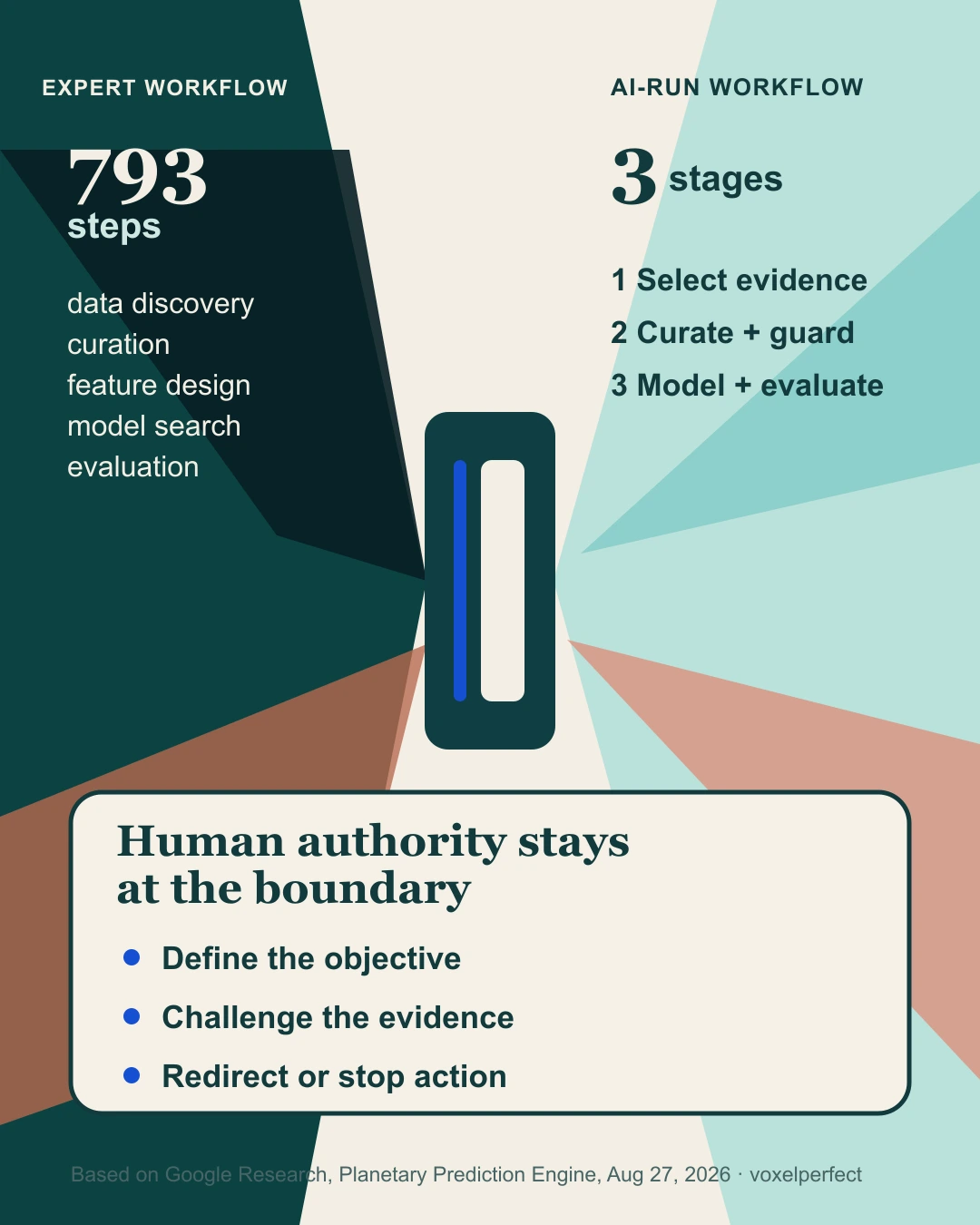
Original voxelperfect diagram based on the workflow described in Google's Planetary Prediction Engine paper.
Task Automation Is Becoming Workflow Automation
In “The Future of Work Is Not White Collar Versus Blue Collar”, I argued that AI automates tasks rather than collars. Occupations change as some tasks move to machines and new ones form around them.
That remains true.
PPE adds a harder development: tasks do not always move one at a time. An agentic system can connect them into an operating loop and take over the coordination between them.
This matters because coordination is where much professional expertise lives.
A good analyst does not create value only by cleaning a table or tuning a model. They know why one dataset is admissible, when a proxy becomes misleading, which error is tolerable, what comparison is fair, when a result conflicts with field knowledge and whether the question being modeled is the question the institution actually needs answered.
PPE tries to encode several of those practices directly. It gives provenance and licence quality the highest weight in dataset selection. It checks for target leakage. It separates training and validation artifacts. It reacts to catastrophic generalization failures. It records data sources and produces a report.
That is precisely why the system is interesting.
It is also why “the human will review it” is not a sufficient operating model.
When the machine performs hundreds of intermediate steps, the reviewer may see only the final map, score or recommendation. The better the automation becomes, the easier it is for the human role to collapse from expert participation into ceremonial approval.
Oversight Without Authority Is Theater
The European Union's AI Act provides a more serious definition of oversight than most corporate slogans. For high-risk systems, the people assigned to oversight must have the competence, training and authority needed to understand limitations, avoid automation bias, interpret outputs and intervene or stop the system.
Authority is the important word.
For an AI-supported prediction system, meaningful human authority has at least three layers.
Authority over the objective
Someone must decide what the system is optimizing and whose problem is being represented.
Predicting where cases may rise is not the same as deciding where scarce clinics, vaccines or food assistance should go. A technically accurate target can still be institutionally wrong if it ignores access, trust, logistics, rights or the communities affected by the decision.
The person defining the question needs the authority to reject a convenient formulation that does not match the real decision.
Authority over the evidence
Someone must be able to challenge which data and proxies are allowed to shape the result.
PPE's own limitations show why. High-resolution features can reduce generalization. Causal direction can remain ambiguous. A signal may be predictive because it reflects a structural inequality that the institution should repair, not reinforce.
A reviewer who cannot inspect provenance, question assumptions, demand another baseline or exclude a problematic feature does not control the evidence. They merely receive it.
Authority over action
Someone must decide whether the output is ready to influence the world.
That includes the ability to pause deployment, narrow the use case, require field validation, change an intervention, escalate uncertainty and create a route for affected people to challenge the decision.
The NIST AI Risk Management Framework makes the same point operationally: roles and responsibilities for human-AI configurations should be explicit, practitioners should be trained, system limitations should be documented and human oversight should be defined and assessed.
If the person in the loop lacks these powers, the organization has not preserved human authority. It has transferred risk downward while keeping decision rights elsewhere.
Expertise Moves to the Boundaries
PPE does not make domain expertise irrelevant.
It moves the most valuable parts of expertise toward the boundaries of the automated system.
The work becomes:
- translating an institutional need into a valid predictive question;
- defining acceptable evidence and error distributions;
- designing evaluations that reflect real operating conditions;
- recognizing when a technically strong result is socially or causally weak;
- connecting model output to field knowledge and affected communities;
- monitoring drift, failure and unintended consequences;
- and owning the decision to deploy, constrain or stop the system.
This is more precise than saying that humans will “do judgment.”
Judgment needs objects, methods and decision rights. It needs access to the system's assumptions, logs, data lineage and evaluations. It needs time to investigate anomalies. It needs institutional permission to disagree with a fast, confident and expensive machine.
Without those conditions, the worker becomes an exception handler: responsible when the system fails, but unable to shape the system while it succeeds.
That is a poor future of work.
It is also a poor control architecture.
Automation Can Break the Apprenticeship Ladder
There is another problem hidden inside end-to-end automation.
People usually learn to challenge a workflow by performing it.
A junior geospatial analyst develops intuition by cleaning awkward datasets, making bad joins, seeing leakage inflate a score, comparing models, discovering that a plausible proxy fails in one region and defending a result to somebody who understands the local context.
If the entire pipeline disappears behind one natural-language request, where does that expertise come from?
There is evidence that AI assistance can accelerate learning. In the published study “Generative AI at Work”, access to an AI assistant raised customer-support productivity by 14% on average and by 34% for novice and lower-skilled workers, suggesting that the system helped disseminate the practices of stronger performers.
But assistance and absorption are different designs.
An assistant can expose reasoning, offer feedback and let a worker perform the task with support. An autonomous workflow can remove the practice entirely. If organizations optimize only for immediate throughput, they may eliminate the repetitions through which future experts learn to recognize failure.
Training therefore has to become part of the production architecture.
Teams deploying workflow-level AI should create deliberate learning mechanisms:
- shadow runs in which people build or inspect a manual baseline;
- replayable traces that show why data and models were selected;
- structured challenges in which workers try to break the result;
- comparison exercises across alternative objectives and evidence sets;
- supervised authority that expands as competence is demonstrated;
- and incident reviews that teach the organization, not only repair the model.
The goal is not to preserve obsolete manual work for nostalgia.
It is to preserve the path by which people become capable of governing the automated work.
Worker Agency Is Part of System Quality
The OECD's surveys of employers and workers found widespread task reorganization where AI had been adopted. Around three-quarters of AI users said it increased their pace of work, while worker consultation about technology adoption was associated with better outcomes and working conditions.
That combination should guide leaders.
Automation can increase capability while making work more intense. It can create new tasks while concentrating control. It can improve decisions while narrowing the worker's ability to question how those decisions are made.
Worker participation is therefore not a soft addition to an otherwise technical deployment. The people closest to the workflow often hold the tacit knowledge required to identify missing constraints, implausible outputs, unsafe shortcuts and the difference between a metric and the real objective.
They should help define:
- which decisions are eligible for automation;
- which evidence is acceptable;
- where intervention points sit;
- what must remain visible;
- how performance and workload will be measured;
- and what happens when the system and the practitioner disagree.
This does not mean every decision becomes a committee meeting.
It means the operating model treats workers as contributors to system design rather than as liability absorbers positioned after it.
The Leadership Test
Google's Planetary Prediction Engine is an experimental research system, not proof that every analytical team is about to disappear.
It is still a preview of a wider transition.
Agentic AI will increasingly automate sequences of expert work rather than isolated outputs. As that happens, leaders will be tempted to keep one person at the end of the chain and call the design human-centred.
That will not be enough.
Before automating an expert workflow, leaders should answer five questions:
- Who has the authority to define or reject the objective?
- Who can inspect and challenge the evidence and assumptions?
- Who can pause, redirect or stop the system?
- How will new practitioners acquire the expertise needed to exercise that authority?
- How will the people affected by the decision contest it?
The future of work should not reduce people to doing whatever AI cannot yet perform.
It should preserve human authority over why the system acts, what it is allowed to treat as evidence, where its outputs may be used and when its operation must stop.
AI can run more of the workflow.
Humans still need the power to govern the work.
Sources
- Google Research's Planetary Prediction Engine announcement introduces the experimental Earth AI capability and its intended public-health, food-security, environmental-risk and socioeconomic applications.
- The Planetary Prediction Engine paper describes the three-stage architecture, 793-step Ebola run, benchmark design, reported results, data-provenance controls and limitations.
- The International Labour Organization's 2025 global exposure index supports the distinction between occupational transformation and wholesale replacement.
- The OECD's employer and worker surveys document task reorganization, work-intensity changes, retraining and the relationship between worker consultation and outcomes.
- The NBER paper “Generative AI at Work” provides field evidence on productivity and learning effects among customer-support workers, including the larger gains for novice and lower-skilled workers.
- The EU Artificial Intelligence Act defines effective oversight for high-risk AI systems in terms that include competence, training, authority and the ability to intervene or stop operation.
- NIST's AI Risk Management Framework core supplies the operational guidance on accountability, roles, practitioner proficiency, human oversight and documented limitations.