

Last year, one piece of career advice became strangely popular:
If AI is coming for white-collar work, become a plumber.
I never agreed with it.
Plumbing is skilled, difficult, valuable work. That is not the problem with the advice. The problem is the assumption underneath it: that AI will remain trapped behind a screen while physical work stays protected by the messiness of the real world.
Figure's new Index platform is an important signal that this boundary is already being attacked.
Index pays people to record themselves performing real tasks. Figure says that, during four months in stealth, 44,000 weekly active contributors across 108 countries uploaded more than 16 million videos and earned $15 million. The tasks include cooking, cleaning, laundry, changing oil, serving customers, stocking shelves, and work inside factories, logistics centers, restaurants, and offices.
The videos are not content for people to watch. They are training data for Figure's humanoid robots.
The worker is performing the task today while helping a machine learn how to perform it tomorrow.
That does not mean the machine is ready to replace the worker. It does mean that the old white-collar-versus-blue-collar comfort story is becoming less useful.
Figure Is Building a Labor Market and a Data Pipeline at the Same Time
Figure describes Index as a network of “Creators.” People can record their own work, or households and businesses can book someone through the app to perform tasks. The Index product page makes the intended transition unusually explicit: “Today, services on demand. Soon, robots on demand.”
This is more than another data-labeling marketplace.
Large language models could learn from text, code, images, and video already available online. A robot needs something the web contains far less of: detailed examples of how bodies move through physical environments, manipulate unfamiliar objects, recover from mistakes, and complete goals amid friction and variation.
Figure argues that this is primarily a data problem. Its pipeline filters submissions, checks for fraud, removes duplicates, rebalances tasks and environments, and produces annotations for training. Figure's earlier Project Go-Big reported that its Helix model could transfer knowledge from first-person human video to robot navigation without robot-specific demonstrations.
Index is the attempt to scale that approach from a controlled program into a global supply network.
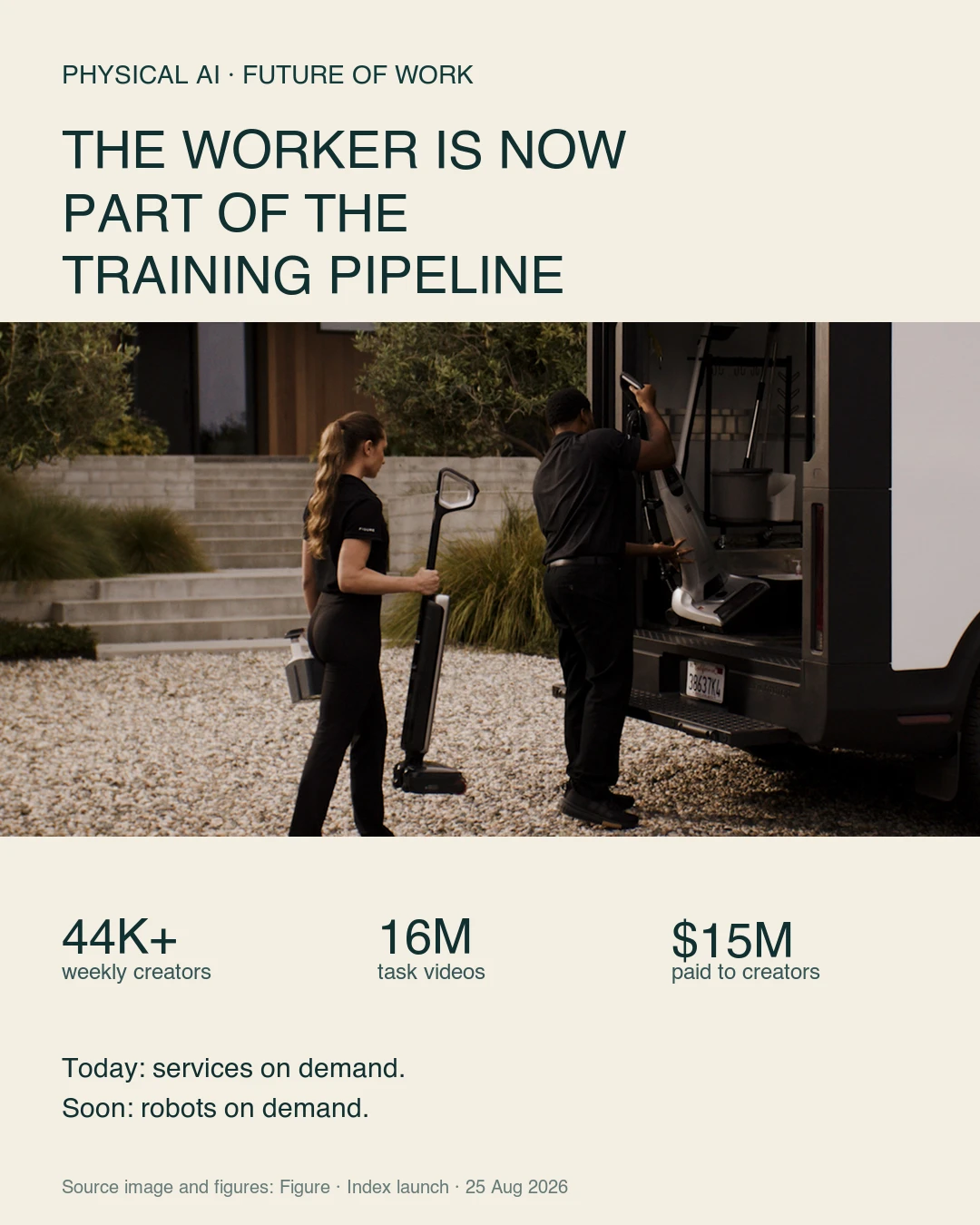
Source image: Figure's Index announcement, August 25, 2026. Figure reports that Index contributors have uploaded 16 million videos and received $15 million in payouts.
The numbers come from Figure and have not been independently audited. The company's claims about generalization also remain company claims. Physical deployment still faces hard problems in dexterity, safety, reliability, maintenance, cost, liability, and operation in unfamiliar environments.
Those caveats matter. But they do not make Index unimportant.
The platform shows where serious robotics companies believe the bottleneck is moving. If the limiting resource is diverse human behavior in real environments, paying thousands of people to produce it is a rational way to accelerate physical AI.
Factories Are the Beginning, Not the Boundary
Industrial environments are the obvious starting point for humanoid robots. They are controlled, repetitive, instrumented, and easier to supervise. The business case can be measured against shifts, throughput, injuries, and downtime.
Figure already has a commercial agreement with Catalyst Brands focused on physically demanding distribution and logistics tasks. That is familiar automation territory.
Homes and shops are much harder.
A factory can standardize the workstation. A home contains different kitchens, handles, cupboards, lighting conditions, floor plans, pets, clutter, and human preferences. A retail shelf changes by location and season. A restaurant combines objects, people, safety rules, interruptions, and constant improvisation.
That long tail of variation is exactly what Index is designed to capture. Every contributor brings a different environment, object set, and way of completing a task.
This is why physical AI may spread more slowly than generative AI while still spreading further than many career forecasts assume. The obstacles are real, but data, hardware, simulation, and deployment learning are all improving at the same time.
“Become a plumber” was never a workforce strategy. It was a bet that one particular bottleneck would persist.
Index is evidence that companies intend to spend heavily to remove it.
AI Does Not Automate Collars. It Automates Tasks
The white-collar-versus-blue-collar frame treats occupations as indivisible units.
They are not.
A plumber diagnoses ambiguous failures, navigates unfamiliar spaces, communicates with customers, prices work, selects materials, performs precise physical operations, and takes responsibility for consequences. Some of those tasks are easier to automate than others.
The same is true for a lawyer, teacher, warehouse worker, nurse, manager, electrician, designer, or software engineer.
AI pressure arrives at the task layer first. It changes the bundle of work before it necessarily eliminates the occupation.
This is consistent with the International Labour Organization's 2025 analysis, which found that one in four workers worldwide had some exposure to generative AI but concluded that transformation was more likely than wholesale redundancy because most occupations still require human input. That study focused on generative AI, not humanoid robotics, but its task-level logic is the useful part.
Physical AI widens the set of exposed tasks.
It also creates new ones: recording demonstrations, supervising fleets, investigating failures, maintaining systems, designing environments, handling exceptions, certifying safety, translating customer needs, and deciding where automation should stop.
The future of work will not be a clean transfer from office workers to trades. It will be a continuous rebundling of tasks across both.
IKEA Shows That Automation Is Also a Management Choice
The task-level view is not only a warning. It also creates room for a more optimistic strategy.
At IKEA's largest retailer, Ingka Group, the AI chatbot Billie began handling simpler customer enquiries in 2021. Ingka reported that, between 2021 and 2023, Billie resolved approximately 47% of the enquiries it received: 3.2 million interactions and nearly €13 million in savings.
The important part is what happened around the automation. Ingka says it reskilled 8,500 call-centre co-workers in remote interior design, digital retail sales, relationship-building, and complex problem-solving. Its remote customer meeting points produced €1.3 billion in sales in FY22, although that total should not be attributed to the chatbot or reskilling programme alone.
This is a useful counterexample to the assumption that efficiency must translate directly into fewer people. IKEA automated a set of repetitive tasks and invested in adjacent work where product knowledge, taste, context, trust, and human conversation mattered more.
The case is based largely on the company's own reporting, and it does not prove that every transition was painless or that every employer will make the same choice. It shows that displacement is not purely a technical outcome. Technology changes the task frontier; leaders decide whether the productivity gain becomes only a cost reduction or also finances new capabilities, services, and opportunities for people.
Figure and IKEA therefore illuminate two sides of the same transition. Figure shows more physical tasks becoming learnable by machines. IKEA shows people moving when routine tasks become automatable.
That optimistic outcome is possible. It is not automatic. It has to be designed.
“Higher-Value Work” Needs a Transition Plan
Automation announcements often promise that people will move to higher-value work.
Figure uses that language in its Catalyst announcement. The direction may be right. Repetitive and physically punishing work should be reduced where machines can do it safely.
IKEA offers one concrete version of an operating plan: identify the adjacent roles, invest in training, and build a service in which the newly developed human capabilities create value. Without those specifics, “workers will move up” remains only a promise.
Move to which role? With what training? Who pays for the transition? How long does it take? What happens to wages while the supply of workers chasing the remaining tasks rises? Who owns the productivity gains? What voice do workers have when their daily behavior becomes training data for the system changing their occupation?
Index makes this tension visible. It creates paid work today by turning human activity into a productive asset. That asset is intended to make automated labor more capable tomorrow.
There is nothing inherently wrong with that exchange. People have always taught tools, apprentices, and organizations how work is done. The difference is scale, reuse, and ownership. One recorded demonstration may help a model perform the task across many machines and locations.
We therefore need more than a payout. We need clear consent, understandable data rights, safe recording practices in homes and workplaces, transparency about how contributions are used, and serious transition support where automation changes demand.
The gig platform is not the solution to the future of work. It is part of the transition—and a preview of the questions that transition will create.
The Education Problem Is Larger Than AI Literacy
If both cognitive and physical tasks can move, education cannot optimize for a list of supposedly safe occupations.
It has to build adaptive capacity.
That includes:
- deep foundational knowledge, because judgment without knowledge is just confidence;
- analytical and critical thinking, so people can inspect evidence and challenge machine output;
- creativity and problem framing, so they can define valuable work rather than only execute instructions;
- decision-making under uncertainty, including responsibility for consequences;
- systems thinking, because automation changes workflows, incentives, and institutions together;
- communication, empathy, leadership, and collaboration;
- technological fluency, including the ability to direct, evaluate, and improve AI-supported work;
- and the habit of learning repeatedly across a career.
These are not decorative “soft skills” added after the real curriculum. They are the operating capabilities people need when execution becomes cheaper and occupational boundaries keep moving.
The World Economic Forum's 2025 employer survey already places analytical thinking, resilience, leadership, creative thinking, curiosity, and lifelong learning alongside technological literacy and AI skills. Its forecasts should not be treated as precise predictions, but the direction is credible: employers expect technical and human capabilities to become more valuable together.
The OECD goes further. It argues that education systems need to reconsider what knowledge, skills, and attitudes matter when AI and robotics can reproduce more human capabilities. Simply teaching students how to use today's tools is too narrow.
I agree.
Students should learn with AI, without AI, and about AI. They should have to produce, verify, explain, revise, and defend decisions. Assessment should test not only whether they can reach an answer, but whether they understand the domain well enough to know when the answer is weak or dangerous.
I made a related argument in “AI Has Made the One-Mode Exam Obsolete”. Physical AI makes the redesign more urgent. Education is not preparing people only for a changing software interface. It is preparing them for an economy in which the boundary between thinking work and physical work is itself becoming programmable.
The Durable Advantage Is Not a Job Title
I would not advise a young person to become a plumber because robots cannot do plumbing.
I would advise them to become an excellent plumber if they care about the work, develop judgment that customers trust, understand the systems around the task, learn to use new tools, and remain capable of moving as the occupation changes.
I would give the same advice to a programmer, teacher, designer, lawyer, manager, or doctor.
There are no permanently safe collars.
There are capabilities that remain valuable across changing task bundles: judgment, creativity, critical thinking, responsibility, communication, domain depth, and the ability to learn.
Even those capabilities will increasingly be augmented by AI. Their value does not come from being forever impossible to automate. It comes from helping people decide what should be done, what good looks like, what risks are acceptable, and who is accountable.
Figure's Index is not proof that humanoid robots will soon do every job in every home and shop.
It is proof that the physical world is now being converted into training data at labor-market scale.
That is an important move.
The right response is not to run from white-collar work into blue-collar work, or from blue-collar work back into an office.
It is to redesign education and work around a harder truth:
AI will keep moving. People need the capacity, support, and agency to move with it.
Sources
- Figure's Index announcement and product page provide the contributor, upload, payout, geography, task, and pipeline figures, and state the company's services-to-robots roadmap.
- Figure's Project Go-Big describes its human-video training approach and reported human-to-robot transfer result; its Catalyst Brands agreement documents the initial commercial focus on distribution and logistics.
- Ingka Group's account of Billie and remote selling reports the chatbot's enquiry volume and savings, the reskilling of 8,500 call-centre co-workers, the capabilities taught, and FY22 remote-sales figures.
- The International Labour Organization's 2025 update supplies the task-exposure and job-transformation evidence for generative AI.
- The World Economic Forum's Future of Jobs 2025 skills analysis reports employer expectations for analytical, creative, technological, leadership, and adaptive skills.
- The OECD's education policy paper examines how AI and robotics may require education systems to rethink curriculum priorities rather than merely add tool training.