

Mark Zuckerberg has identified the right political question for the AI era.
He has not yet answered it.
In his new 6,500-word essay, The Future Is for Everyone, Zuckerberg argues that the central risk of superintelligence is not only what the technology can do. It is who controls it. A small number of institutions with exclusive access would acquire extraordinary power over science, work, government and everyday life. His alternative is personal superintelligence distributed to billions of people, aligned to their goals and available free or at an affordable price.
That diagnosis is stronger than the utopian language surrounding it. Concentrated intelligence would create concentrated power. A future in which three or four companies own the models, the infrastructure, the interfaces and the rules would not become democratic merely because billions of people could open an app.
But this is also the contradiction inside Zuckerberg's manifesto.
He presents Meta as the company that will solve concentration by giving everyone a Meta-controlled agent.
Distribution is not the same as decentralization. Access is not the same as agency. A product can reach billions of people while leaving the important decisions—model choice, compute allocation, privacy, memory, pricing, safety policy and continuity—inside one company.
The AI future will not be for everyone because everyone receives an account.
It will be for everyone when people have a credible right to leave.
TechCrunch Is Right About the Trust Gap
Russell Brandom's TechCrunch critique makes the most important point early: Zuckerberg's abstractions keep turning into Meta products.
The universal tutor resembles a consumer chatbot. The personal agent that understands your relationships, health, career and finances resembles a much more intimate version of Meta AI. The promise of universal access becomes a freemium service, with paid compute allocated through a proposed dynamic auction. A theory about distributing power becomes a commercial architecture in which Meta still owns the interface and the market.
TechCrunch reads this as a failure of public communication and trust. That is fair. Americans are already cautious: a February 2026 Pew Research Center survey found that 71 percent expected AI to make personal information less secure, while about six in ten lacked confidence that US companies would develop and use AI responsibly.
Meta cannot ask people to evaluate its privacy promises without history. In 2019, the Federal Trade Commission imposed a $5 billion penalty and a 20-year privacy order after alleging that Facebook violated an earlier order and deceived users about control of their personal information. The settlement created independent privacy oversight precisely because promises alone were insufficient.
Zuckerberg's new essay does acknowledge this problem more directly than some summaries suggest. He proposes a fully private agent mode that even Meta cannot access, an independent board process for model-release criteria and more government visibility into frontier development.
Those are meaningful commitments if implemented well.
They are still commitments granted by the operator.
The deeper trust question is architectural: what can a user do when the commitment changes, the product is discontinued, the price rises, the model's behavior shifts or the operator's interests diverge from their own?
Zuckerberg Is Right About the Balance of Power
The strongest part of the manifesto is its rejection of a single benevolent superintelligence.
Humanity does not share one objective function. People, communities and countries disagree about values, risk and the good life. Any centralized model would encode some priorities over others, whether its developer called that alignment, safety or policy.
Zuckerberg therefore frames AI safety as a balance-of-power problem. Multiple people and institutions should possess capable systems that check one another. No lab, government or model should become the only source of intelligence.
That is a useful correction to an AI debate that often treats model behavior as if it could be separated from ownership and deployment. As I argued in The Model Is Never Neutral, every system carries choices about its data, policies, incentives and operating context. Pluralism requires more than tuning one model until everyone accepts it. It requires multiple models, operators and governance regimes.
Zuckerberg also defends open models and rejects a ban on leading foreign open-weight systems. That is consistent with the argument in The Open-Weight Coalition: the answer to competitive anxiety is stronger domestic open models, targeted controls around proven risks and a broad ecosystem that keeps builders from becoming permanently dependent on a few closed APIs.
Where the manifesto slips is in treating wide delivery as evidence that power has moved to the individual.
It has not moved if the user cannot move it.
Kimi K3 Shows Why Access Has Layers
Kimi K3 made the limits of a binary open-versus-closed debate unusually visible.
Moonshot AI released a frontier-competitive model with public weights, but the model is enormous. As detailed in The Real Kimi K3 Paradox, its quantized checkpoint is roughly 1.56 terabytes and current reference deployments start with data-center hardware. The artifact is available; operating it remains scarce.
That does not make the weights theatrical. It means access is a stack:
- the artifact must be obtainable;
- the license must permit the intended use;
- runtimes must support the model;
- suitable compute must be affordable;
- an organization must be able to evaluate, secure and operate it.
Open weights change power because they allow multiple parties to build the remaining layers. A cloud, specialist host, enterprise or government can operate the authentic model without asking the developer for API access. Most people may still use a managed service, but the service can come from competing operators.
Meta's release alongside the manifesto makes the other end of the stack concrete. Muse Glimmer is a 30-billion-parameter agentic model whose released artifacts are licensed under Apache 2.0. Meta says its quantized variants fit consumer hardware with 24 or 32 gigabytes of memory, and it has published support for local runtimes and agent workflows.
Kimi K3 expands the capability that can exist outside a proprietary API. Muse Glimmer expands the number of people who can operate an agent directly.
Both matter. Frontier-scale open weights create provider competition and strategic optionality. Smaller local models create direct possession, private execution and practical exit rights.
This is the distinction Zuckerberg's essay needs. A free Meta service distributes consumption. An operable open-weight model distributes capability.
Personal AI Needs a Control Test
A personal agent is more sensitive than a social network account.
Zuckerberg imagines an agent that understands a person's goals and “everything” they care about, then works continuously across relationships, health, money, work and home. If such a system becomes useful, it will accumulate an unusually rich combination of memory, permissions, preferences and behavioral history.
The wrong test is whether the service is personalized.
The right test is whether the user controls the personalization.
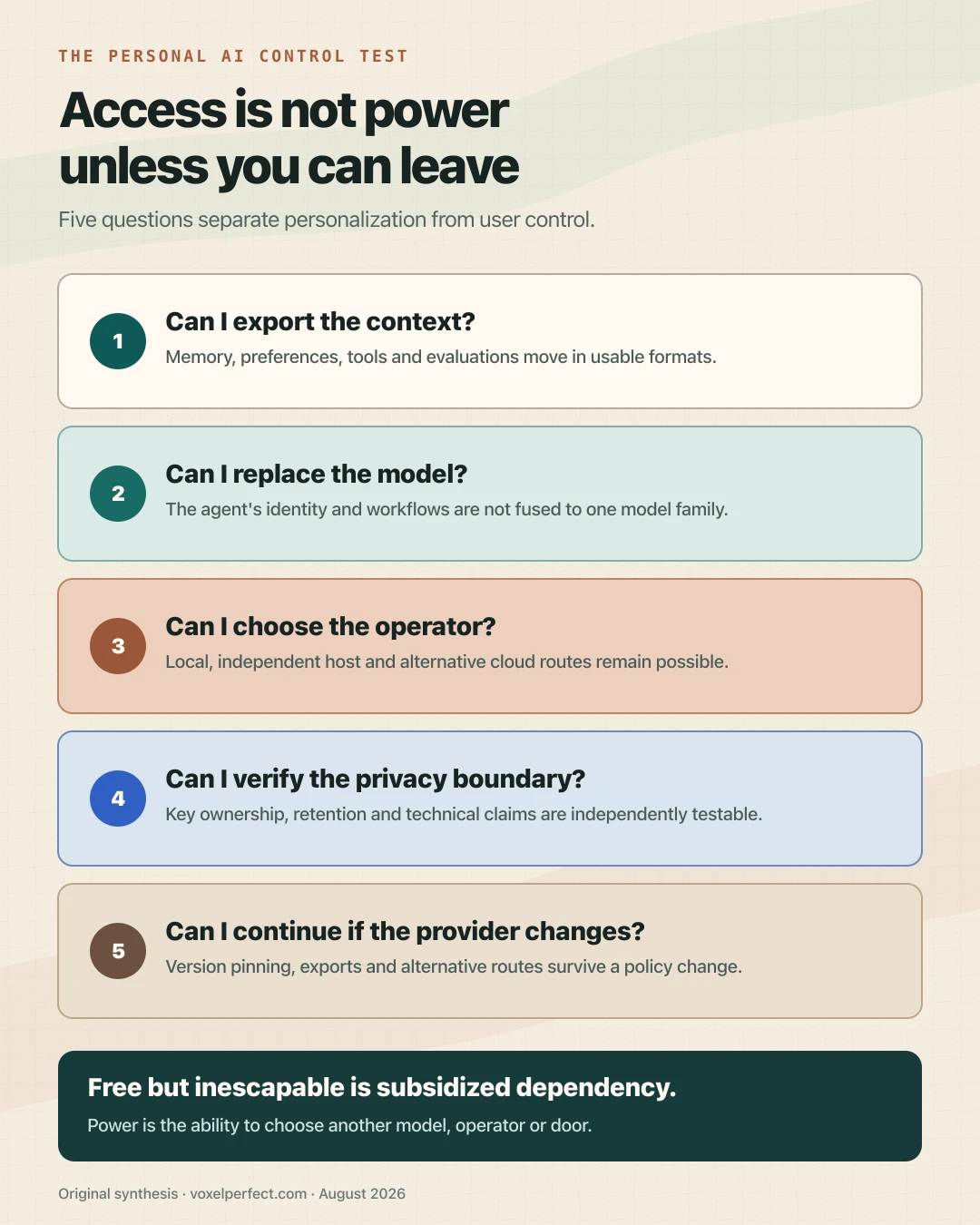
Ask five questions:
- Can I export the context? Memory, preferences, conversation history, tool configuration and evaluation data should move in usable formats.
- Can I replace the model? The agent's identity and workflows should not be fused permanently to one model family.
- Can I choose the operator? A user should be able to run the system locally, use an independent host or move to another cloud where the model permits it.
- Can I verify privacy? “Private mode” should have inspectable technical boundaries, clear key ownership, narrow data retention and independently tested claims.
- Can I continue if the provider changes? Critical workflows need version pinning, export paths and alternatives that survive a product or policy change.
These are not edge-case requirements for technical enthusiasts. They determine who holds bargaining power after an agent becomes embedded in daily life.
A service that is free but inescapable is not individual empowerment. It is subsidized dependency.
Free Access Can Still Produce a Hierarchy
The manifesto promises free versions for billions of people and paid access to more compute through a dynamic auction.
This may broaden availability. It does not abolish scarcity.
Compute remains finite, as Zuckerberg himself emphasizes. A free tier will therefore differ from a paid tier in speed, capability, context, autonomy or availability. An auction may allocate scarce capacity efficiently in a market sense, but it will also allocate more intelligence to those who can pay more for it.
That does not make the idea illegitimate. Almost every digital infrastructure market has service tiers. The problem is the claim that a price mechanism itself distributes power widely.
It distributes access according to purchasing power.
This is where our Kimi K3 analysis becomes more useful than a generic argument about free AI. Open weights cannot make compute abundant, but they can prevent one company from being the only seller. Smaller models can reduce the amount of compute required. Independent hosts can compete on price and jurisdiction. Local deployment can remove recurring inference charges for some workloads. Public compute can widen access for researchers, schools and smaller firms.
The goal is not a world in which every person owns a data center. It is a world in which no person's agent depends on one irreplaceable allocation system.
Trust Is a Topology, Not a Tone
TechCrunch is right that Zuckerberg's optimism sounds detached from the ways AI can fail today. But a more cautious manifesto would not solve the underlying problem.
Trust cannot be restored by changing the tone from confident to concerned.
It has to be built into the topology of the market:
- open and meaningfully licensed model artifacts;
- small models that ordinary organizations can operate;
- independent hosts and interoperable runtimes;
- portable agent memory, tools and evaluations;
- user-held or independently controlled encryption keys;
- external audits and release governance with real authority;
- procurement rules that require tested exit paths.
This is also the practical meaning of AI sovereignty. Sovereignty is not building every layer domestically or personally. It is maintaining a credible ability to substitute the model, operator or jurisdiction without rebuilding the whole system.
Meta can contribute materially to that future. Muse Glimmer's permissive open-weight release is more persuasive than any paragraph in the manifesto because it gives other people something they can possess and operate. Releasing capable models, supporting local runtimes, enabling portable agent state and making private execution real would convert a promise of empowerment into enforceable options.
But Meta cannot be the proof that Meta should be trusted with personal superintelligence.
The proof has to be that users do not need to trust Meta exclusively.
The Right to Leave Is the Right to Shape the Future
Zuckerberg says the AI future should be built around individual empowerment, invention and a balance of power.
I agree.
That philosophy leads to a more demanding product and policy conclusion than the essay acknowledges. Individual empowerment requires control over data and memory. Invention requires access to capable artifacts and affordable infrastructure. A balance of power requires multiple models and operators that users can actually choose among.
The future is not decentralized because a centralized platform serves everyone.
It becomes decentralized when people can inspect the system acting for them, take their context elsewhere, choose who operates it and continue when any one provider says no.
Access gets a person through the door.
Power is the ability to choose another door.
Sources
- Mark Zuckerberg's The Future Is for Everyone sets out Meta's arguments for personal superintelligence, distributed access, open models, private agent modes, dynamic compute allocation and independent release oversight.
- Russell Brandom's TechCrunch critique examines the trust gap, the manifesto's product assumptions and the difference between optimistic abstractions and current AI failures.
- Pew Research Center's 2026 survey provides the cited findings on AI, privacy and confidence in corporate responsibility.
- The Federal Trade Commission's 2019 Facebook settlement documents the penalty, earlier-order violations alleged by the FTC and the resulting privacy-oversight structure.
- Meta's Muse Glimmer release and Hugging Face model card document the model size, released artifacts, Apache 2.0 license, local hardware targets, runtime support and stated limitations.
- Moonshot AI's Kimi K3 repository, Hugging Face release and the current vLLM deployment recipe support the comparison between open artifact access and frontier-scale operability.