

Kimi K3 has produced a wonderfully sharp headline: the world's most powerful open AI model that nobody can actually run.
The tension is real. The conclusion is not.
Moonshot AI's model is enormous. Its published specification describes 2.8 trillion total parameters, 104 billion active parameters per token, native image input, and a one-million-token context window. Its MXFP4 checkpoint occupies roughly 1.56 terabytes on Hugging Face. Sparse activation reduces the computation performed for each token; it does not make the full collection of experts fit on a laptop.
The current deployment recipes make the constraint concrete. vLLM starts at eight GB300 GPUs and recommends multiple nodes for production traffic. SGLang's H100 topology uses four eight-GPU nodes: 32 H100s, not four. These are data-center configurations.
But a model does not become fake-open because an individual developer cannot run it under a desk.
That confuses two different freedoms:
- permission to possess, inspect, modify, and deploy the model artifact;
- the economic and operational ability to serve it well.
Kimi K3 grants much more of the first than a proprietary API. It demands an extraordinary amount of the second. The important question is not whether that contradiction invalidates open weights. It is what happens when access moves from a single model company into a layered market.
K3 Is Frontier-Competitive, Not Simply "The Most Powerful"
Benchmark superlatives travel faster than benchmark caveats.
Independent testing by Artificial Analysis currently places K3 third on its Intelligence Index, comparable to Claude Opus 4.8 and GPT-5.5 while behind Claude Fable 5 and GPT-5.6 Sol. At the time of that evaluation, it was positioned to become the leading open-weight model once the weights were released. That is consequential without requiring the claim that it is the best model at everything.
Moonshot reports strong results in coding, long-horizon agents, and knowledge work. Some comparisons favor K3; others favor proprietary peers. The company's own evaluation notes also show why leaderboard rows are not interchangeable: models use different agent harnesses, some results come from external leaderboards, some are run internally, and fallbacks or refusals can affect scores.
The defensible claim is narrower and more important.
An open-weight model now sits inside the frontier performance cluster. It does not need to win every benchmark to change the market. It needs to be good enough that developers, clouds, enterprises, and governments treat it as a credible alternative.
K3 has crossed that threshold.
Open Is Not the Same as Open Source
Vocabulary matters here.
Moonshot calls K3 open-weight, and that is the more accurate description. The weights, code, and technical report are public under the Kimi K3 License. Most users can run, modify, fine-tune, and redistribute them. But the license requires large model-as-a-service businesses above a revenue threshold to negotiate a separate agreement, and it adds attribution requirements for very large products.
The release also does not provide the full training dataset and complete reproducible training pipeline required by the Open Source AI Definition.
So K3 is not "open source" in the strongest software sense. It is a licensed open-weight release with substantial downstream freedoms and material conditions.
That distinction does not diminish what has been released. It makes the analysis more precise. There are at least three different offers in today's model market:
- Proprietary service: use the model through an interface controlled by its provider.
- Open weights: obtain the trained artifact and exercise meaningful deployment and modification rights.
- Open-source AI system: receive the weights plus the information and code needed to study and reproduce how the system was made.
K3 is clearly different from a closed API even though it does not satisfy the third category.
The Missing Concept Is Operability
A downloadable artifact is not yet an operating capability.
To turn weights into a dependable production service, an organization needs compatible inference software, enough accelerators and high-bandwidth memory, fast interconnects, storage, model-specific kernels, capacity planning, observability, security, evaluations, failure handling, and people who can run the system.
K3 makes this gap impossible to ignore because its scale is so extreme. The model is public. The capability to operate it is scarce.
That is not unique to AI. Linux is open source, but running a global cloud requires capital and operational excellence. Chromium is open source, but building and distributing a trusted browser is a continuing engineering organization. A semiconductor instruction set can be open while fabricating a competitive chip remains expensive.
The freedom to attempt a deployment is not the same as the capacity to succeed at one.
This suggests a better test for model accessibility. Ask whether each layer is available:
- Artifact access: Can you obtain the weights and necessary model files?
- Legal permission: Can you use, modify, fine-tune, and redistribute them for the intended purpose?
- Runtime support: Can mature inference engines load and serve the model on available hardware?
- Compute access: Can you rent or own enough suitable infrastructure at a viable cost?
- Operational readiness: Can you evaluate, secure, observe, govern, and support the service in production?
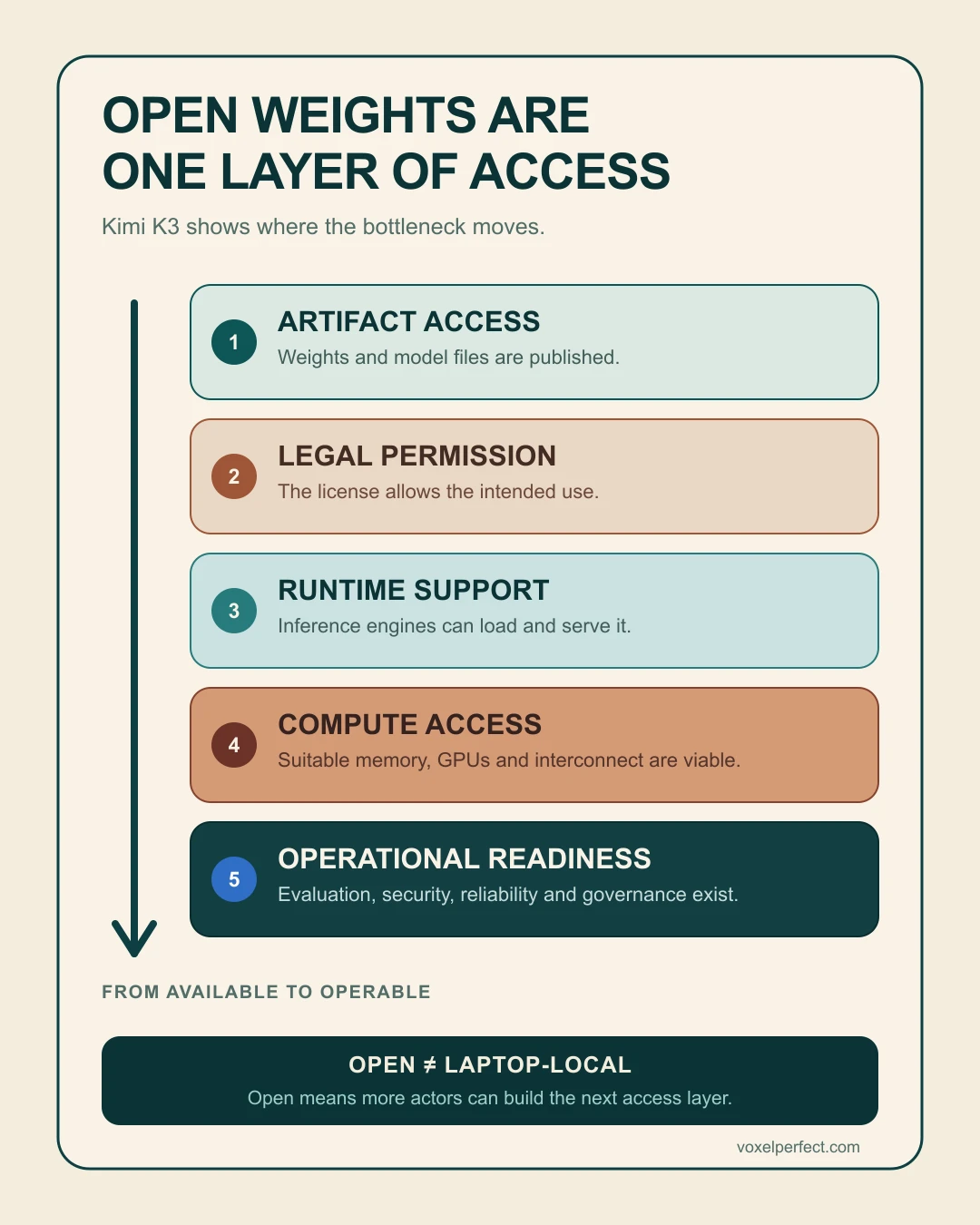
K3 is unusually open at the artifact layer, conditional at the license layer, increasingly supported at the runtime layer, highly constrained at the compute layer, and demanding at the operations layer.
"Open" describes part of that stack. "Usable" describes the stack working end to end.
Why the Weights Still Change the Market
The strongest version of the hardware critique says that if almost everyone uses an API anyway, the weights are theatrical.
That misses who can build the API.
With a proprietary model, the model developer is normally the only entity able to serve the authentic system. It sets the price, regions, rate limits, retention policy, feature roadmap, acceptable-use policy, and discontinuation risk. Resellers may wrap the service, but they remain downstream of the same control point.
Open weights permit multiple operators.
A cloud can optimize the model for its hardware. A specialist host can compete on throughput, geography, privacy, or price. A research lab can inspect behavior directly. A government or large enterprise can deploy inside a controlled environment. An inference project can add kernels and scheduling strategies. A smaller model developer can quantize, fine-tune, merge, or distill the artifact within the license.
Most end users will never run K3 themselves. They can still benefit when several providers compete to run it for them.
That is the same mechanism by which open infrastructure becomes broadly accessible. Most companies do not operate their own database engine internals, Kubernetes control plane, or Linux distribution. The option to do so—and the ability of competing vendors to do it—limits the power of any single supplier.
Open weights turn self-hosting from a universal expectation into an option value.
The option is unevenly distributed. Large clouds and well-funded institutions can exercise it more easily than startups or individuals. But it is not imaginary. It changes bargaining power, continuity planning, security architecture, and the number of organizations that can innovate below the application layer.
The New Gatekeepers Sit Lower in the Stack
K3 does not eliminate concentration. It relocates it.
When weights are closed, control is concentrated in the model lab. When weights are open but enormous, power shifts toward accelerator vendors, cloud operators, inference-engine teams, model hosts, and organizations with deployment expertise.
The gate becomes less about permission from Moonshot and more about access to memory, interconnect, optimized kernels, and capital.
This is a meaningful improvement in some dimensions and a serious constraint in others.
It improves:
- inspectability of the released artifact;
- portability across compatible operators;
- resilience against a single API disappearing or changing terms;
- the possibility of private or sovereign deployment;
- competition in inference and downstream adaptation.
It does not automatically provide:
- affordable local inference;
- reproducibility of the original training process;
- equal access to advanced hardware;
- trustworthy packaging, evaluations, and operational support;
- freedom from every license condition or geopolitical dependency.
This is why smaller open models remain essential. A frontier-scale release expands the maximum capability available outside a proprietary API. Smaller models expand the number of people who can exercise that freedom directly. A healthy ecosystem needs both.
Enterprises Should Buy Optionality, Not a Data Center
The practical lesson is not that every enterprise should acquire a 32-GPU H100 cluster.
Most should not.
They should design model access so that today's API does not become tomorrow's permanent dependency. For K3 or any other open-weight model, that means evaluating four routes:
- the developer's hosted API for speed and simplicity;
- an independent managed host for commercial and jurisdictional choice;
- a dedicated cloud deployment for isolation and predictable capacity;
- self-hosting only when scale, control, or continuity justifies the operational burden.
The organization should test whether prompts, tools, evaluations, and application logic can move among those routes. It should retain workload-level quality and cost data, separate model behavior from provider behavior, and negotiate access to logs, versions, and exit paths.
The strategic asset is not ownership of GPUs.
It is a credible ability to switch.
K3 strengthens that ability even for companies that never download all 1.56 terabytes. The public artifact anchors a wider market of runtimes and operators. It gives buyers an alternative source of supply and gives infrastructure companies something proprietary labs cannot offer: the right to improve the serving layer without asking the model owner to change its API.
Openness Is a Direction, Not a Finish Line
The article that prompted this essay is right about the central discomfort: a public model can remain practically inaccessible to an individual.
But that is not the end of the analysis. It is the beginning.
Kimi K3 shows that AI access is not a binary property. It is a chain of artifacts, permissions, runtimes, hardware, and operating capability. Releasing the weights opens the first gate. It does not pay for the rest of the journey.
The next phase of open AI will therefore be won below the model layer:
- more efficient architectures and smaller derivatives;
- better quantization and hardware support;
- competitive hosting across regions and jurisdictions;
- portable evaluation and governance tooling;
- procurement that values exit options rather than only today's token price.
K3 is not democratic because every person can run it locally.
It is strategically open because no single company remains the only party allowed to turn the artifact into a service.
That is incomplete accessibility. It is also real progress.
The paradox is not that open weights are meaningless without a personal data center.
It is that the model is open while operability remains scarce—and the next competitive market will be built around closing that gap.
Sources
- Syed Ahmer Shah's LinkedIn essay, The Kimi K3 Paradox, supplied the useful tension between public weights and impractical local deployment.
- Moonshot AI's Kimi K3 repository, technical report, release post, and Hugging Face model card document the architecture, weights, evaluations, usage, and release terms.
- Artificial Analysis's independent K3 evaluation provides the comparative intelligence, token-efficiency, and cost-per-task results used here.
- The current vLLM recipe and SGLang deployment cookbook provide the referenced hardware topologies and operational caveats.
- The Kimi K3 License defines downstream rights and conditions; the Open Source Initiative's Open Source AI Definition 1.0 provides the stricter distinction between open weights and an open-source AI system.
- Hugging Face explains how its model download counts are calculated; those counts are evidence of repository activity, not proof of completed self-hosted deployments.