
The original Run Marco adventure
Run Marco began with an idea that a child could understand immediately: give an explorer instructions and see where they lead. The path through the jungle made a program's behavior visible. A step, a turn, or a jump could move the character toward the goal; an instruction in the wrong place gave the player something concrete to revisit.
We began developing the game in early 2014 and launched it publicly that October. It became Allcancode's first product. This page brings together the original game, the children and events around it, and the personal revival I began in 2026. The longer company story is preserved in my 2018 account of Allcancode.
Building a program in a notebook
The original interface placed the program in an illustrated notebook beside the adventure. Children assembled visual instructions, ran them, and watched the character move. The same screen held the instructions and their consequences, so it was possible to look between the two while working out what to change.
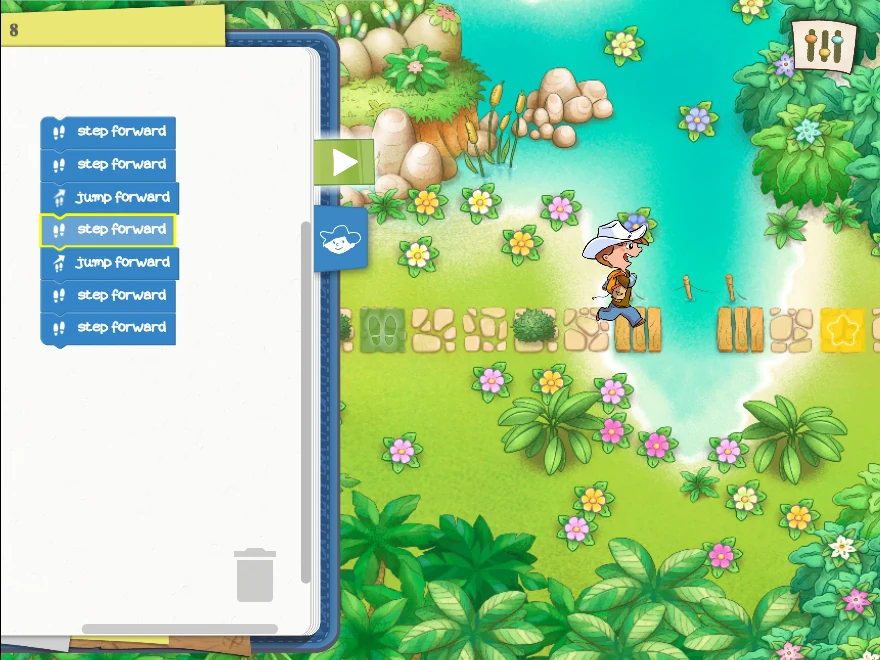
An original gameplay screenshot from the Allcancode archive. The program sits beside the route it controls.
Picture-based instructions introduced commands through the character's actions. The jump guide, for example, showed a take-off and landing around an obstacle. The illustration connected a command to an observable movement before the child used it in a longer program.
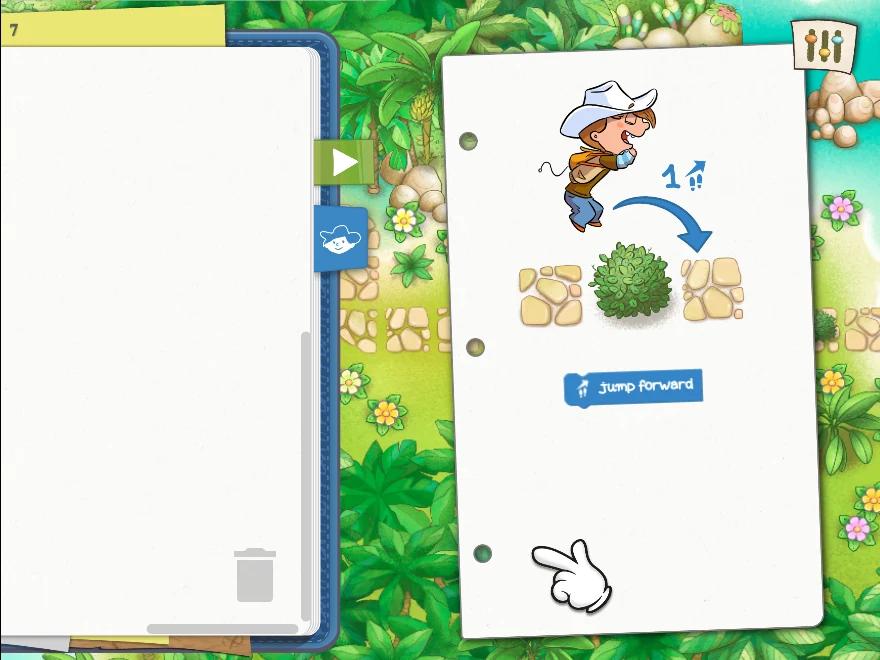
The original illustrated jump guide. These help screens used the same characters and visual language as the adventure.
From individual steps to loops and decisions
As the puzzles developed, a sequence of movements could become a repeated pattern. Conditions added another possibility: the explorer could choose an action according to what was on the trail. The route gave these programming ideas a purpose that could be inspected on screen.
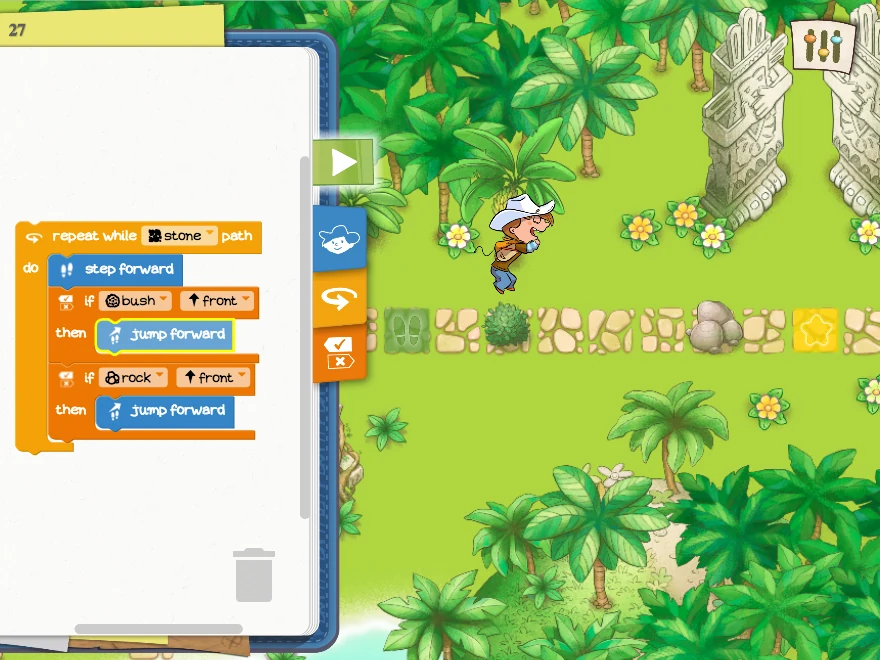
A later original puzzle combining repetition, conditions, and movement. The visual program and the trail remain visible together.
The artwork was part of how the game communicated. Paths, bridges, plants, gestures, and the notebook's command categories gave the learner a consistent world to read. A child could try a program, watch where it stopped or went wrong, and make another attempt without leaving that world.
In the hands of children
Run Marco was also a product we took into workshops and classrooms. The archive records children playing independently on tablets, working beside one another at computers, and joining group demonstrations. Those settings made the game more than an editor and a set of puzzles: they put it in front of the people it was intended for.
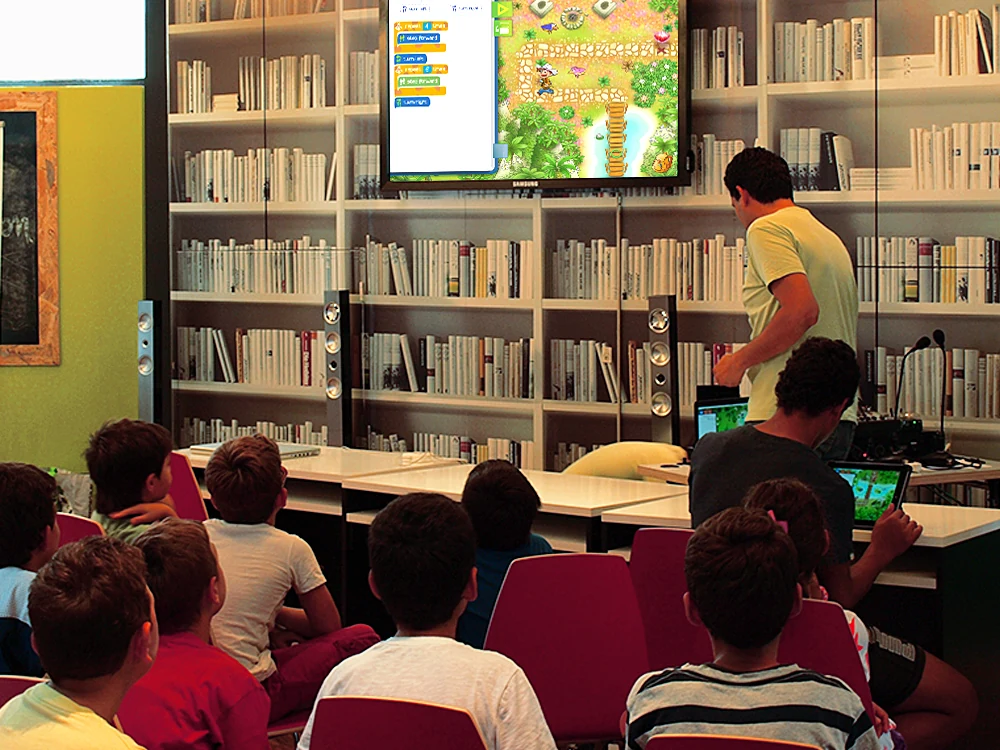
Innovathens, 18–19 October 2014. A group session around the game's public launch, from the Allcancode event archive.
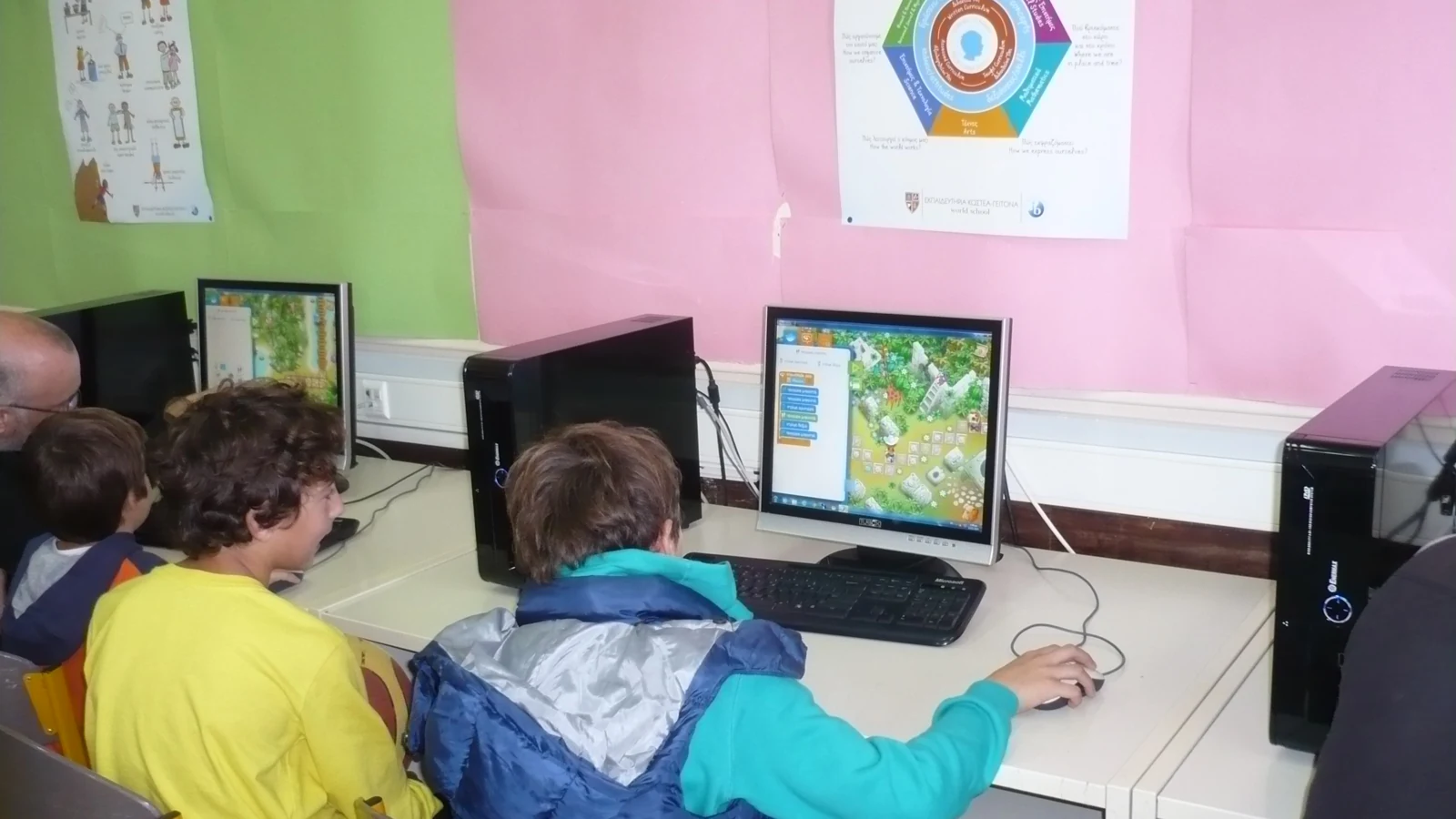
Costeas-Geitonas STEM event, 15 November 2014. Children working together around a Run Marco puzzle. Event and date are preserved in the original photo archive.
These photographs document the game being used. The interest for me is in the interaction they preserve: looking at a route, choosing instructions, and watching what happens, sometimes with someone else alongside to discuss the next attempt.
Christmas Factory in Gkazi
At the Christmas Factory event in Gkazi in 2014, we built physical Run Marco levels. The illustrated routes became paths on the floor, surrounded by scenery from the game. Children could step into an environment they had seen on a screen and move through it themselves.
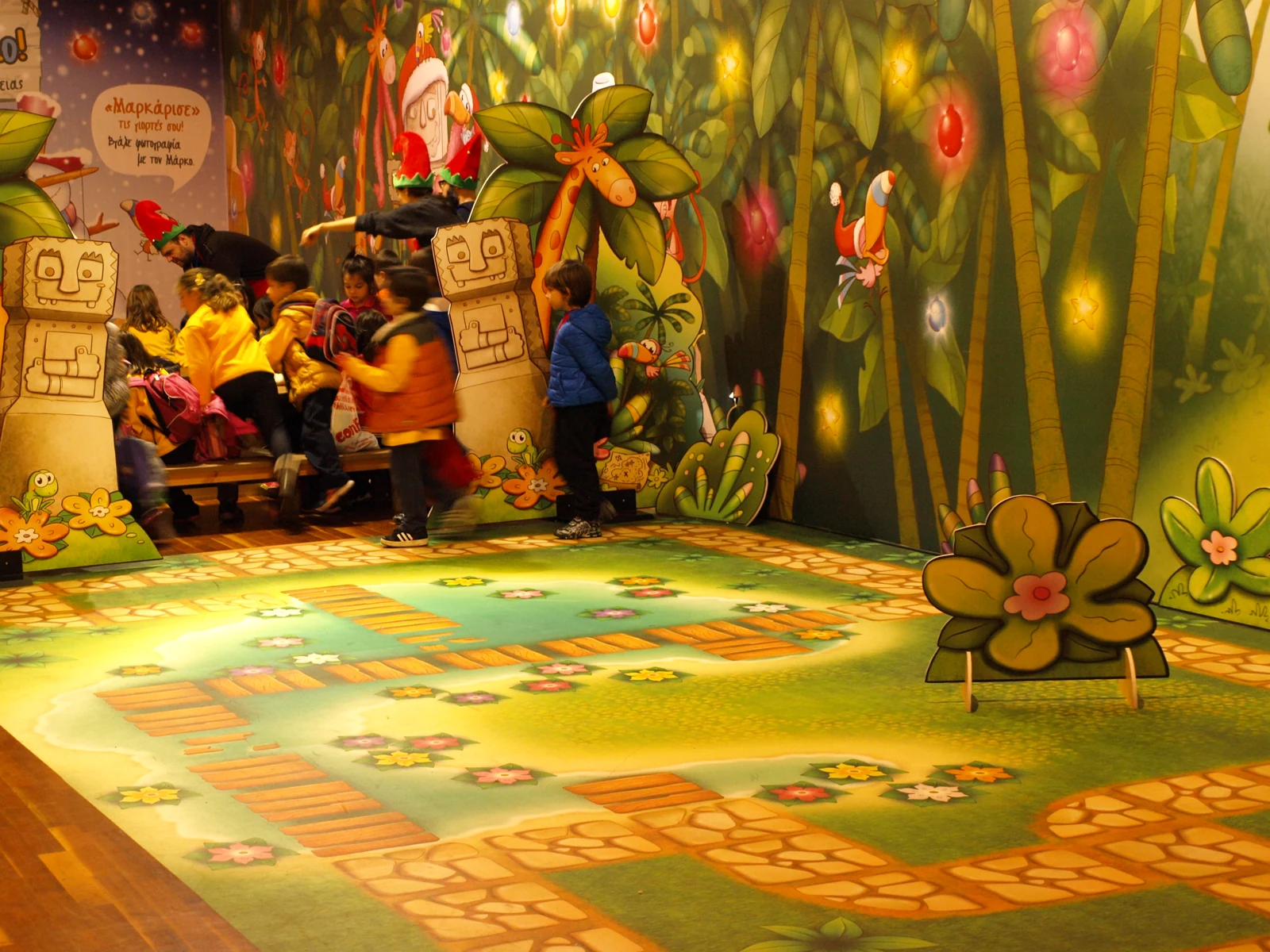
The physical level at Christmas Factory, Gkazi, 2014. The path and surrounding scenery carried Run Marco's illustrated world into the event space.
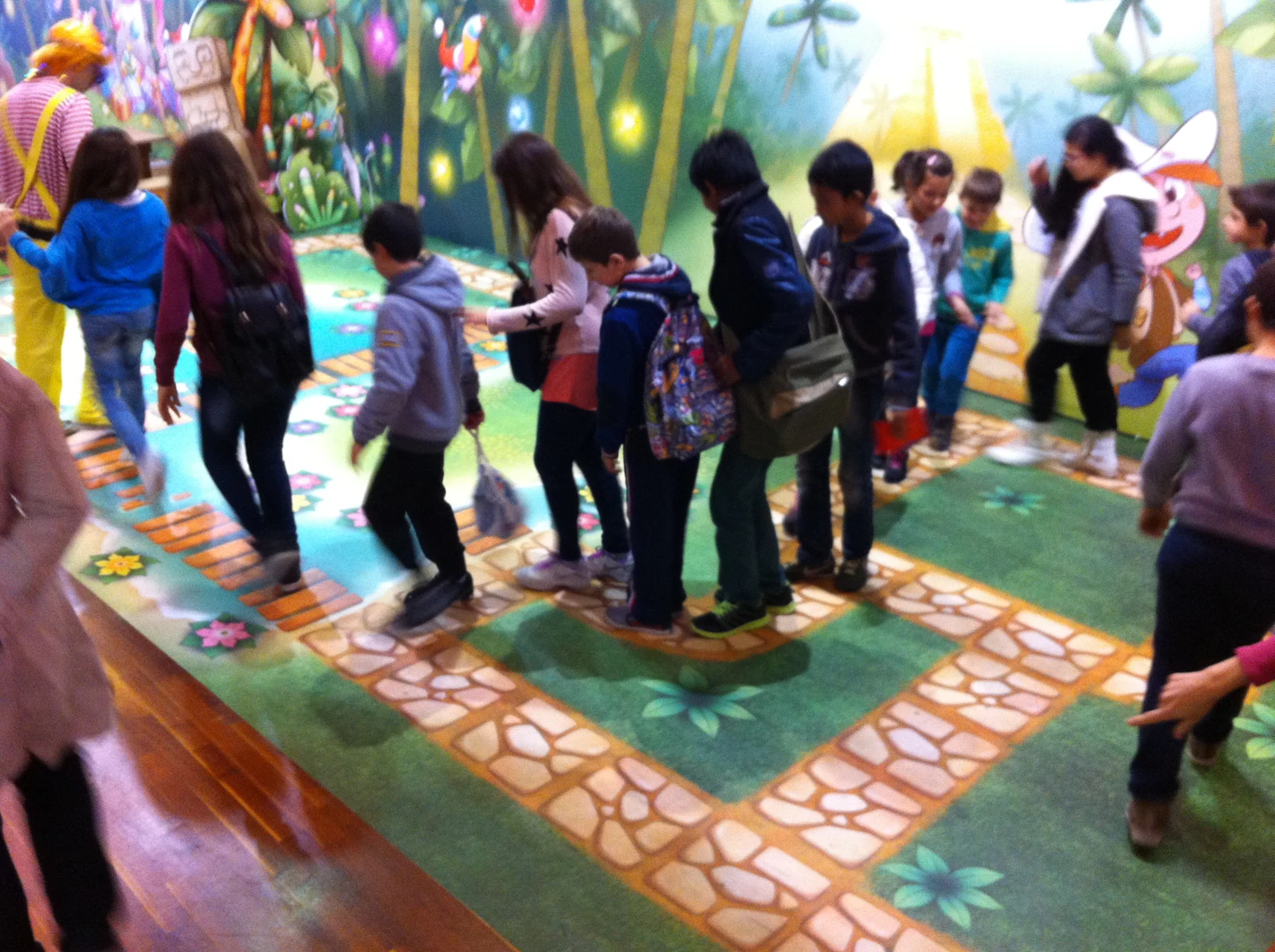
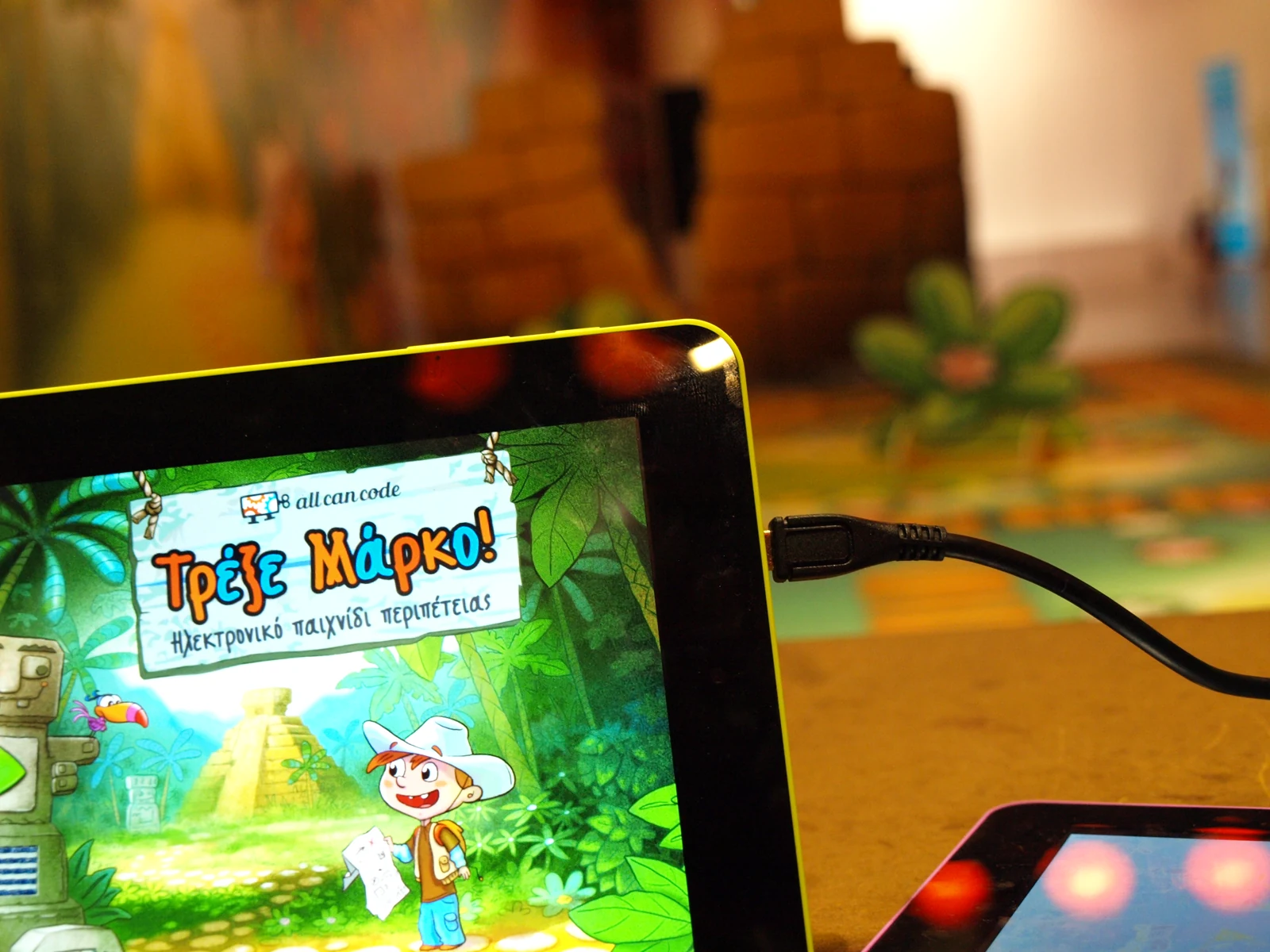
The installation extended the product's visual language beyond the device. The floor paths, plants, and characters were recognizable parts of the same adventure, now at a scale children could inhabit. The photographs preserve both experiences: playing on a tablet and moving through the constructed level.
The people and tools behind the game
Run Marco brought together software, illustration, animation, game design, interface design, story, and sound. My work on engineering and the authoring tools depended on that collaboration. The original Jungle and Christmas team, preserved in the game's credits, included:
- Kostas Karolemeas: team lead and software engineering.
- Ersi Spathopoulou: illustration and scenery.
- Dimitris Karatzaferis: animation.
- Spiros Alvertis: UI and UX design.
- Vangelis Bagiartakis: game design.
- Kostas Haralas: story writing.
- Thanos Papadellis: music and sound engineering.
The tools around the game grew too. We built editors so that content and rules could evolve, and explored giving educators tools to create their own variations. That work became part of the path toward the Allcancode application development platform. The original game and its collaborators remain a distinct chapter within that larger story. My original account
Bringing Run Marco forward in 2026
Allcancode is a completed company chapter. I returned to Run Marco personally to keep its legacy available. The revival reconstructs the game from the surviving release and recovered assets, preserving the original characters and much of their artwork and animation while rebuilding the interface and play flow for today's browser. It continues work made by the original team; it did not begin from an empty canvas.
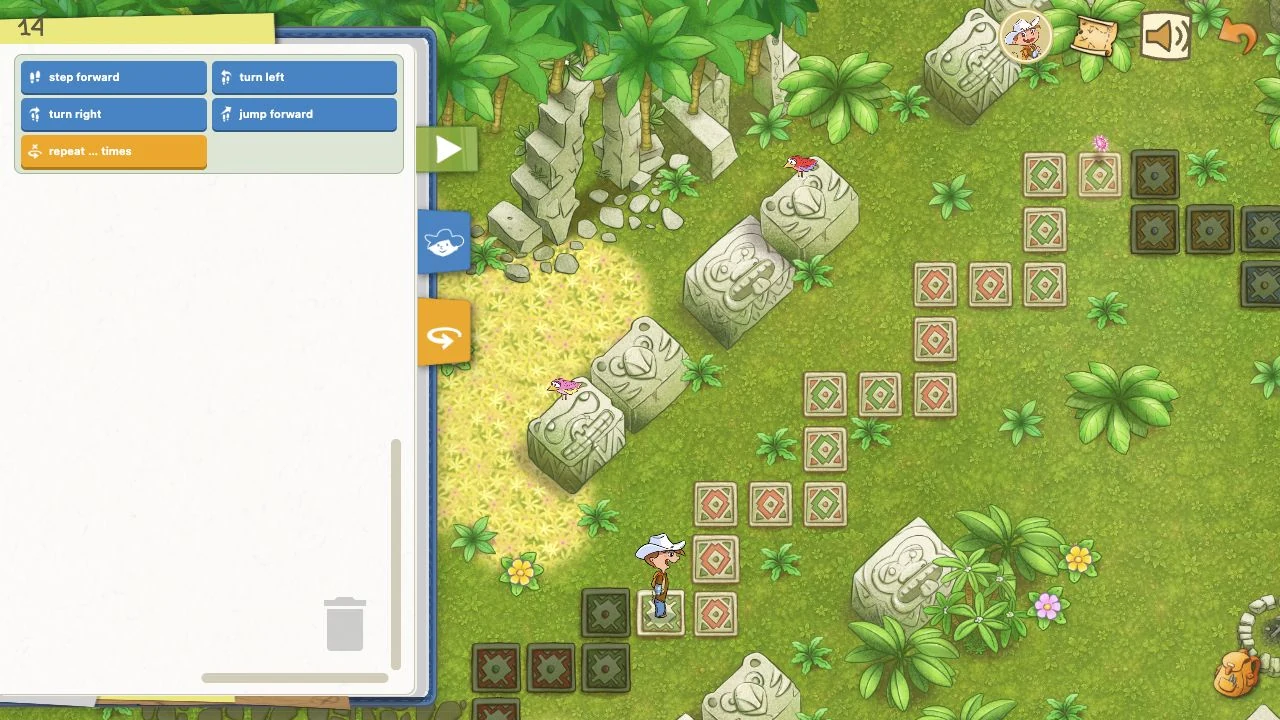
The revived Jungle, captured from runmarco.com on 5 October 2026. The notebook is ready for a new program.
At that date, the game offered 36 Jungle challenges and 12 Winter puzzles, alongside two newer sets: Lost Temple and Clockwork Aegean, with 40 levels each. Both newer worlds remain beta. Temple introduces tools, remembered values, and reusable routines; Aegean develops inputs, local variables, returned values, and an optional advanced recursion sequence. Current game and teaching guide
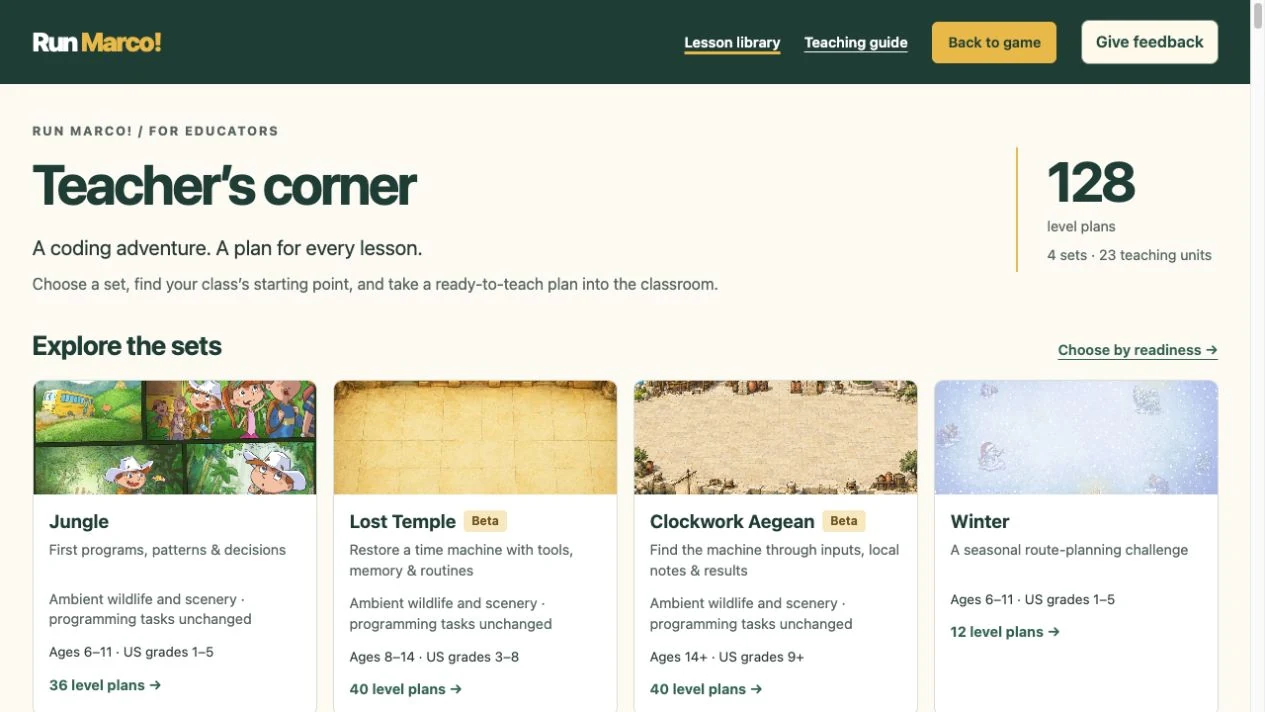
The teacher library, captured on 5 October 2026: 128 level plans across four sets. The plans are in English; revised in-game lesson copy is available in English and Greek.
The revival adds a place for teachers to find objectives, preparation, activities, and questions for individual levels. It also keeps the direct invitation that started the project: open the game, assemble some instructions, and see where the explorer goes. Play Run Marco.
Sources and archive
- My original Allcancode story, first published in February 2018 — development, the October 2014 launch, authoring tools, and the later platform transition.
- Original Allcancode media archive — gameplay screenshots, tablet recording, Innovathens and Costeas-Geitonas workshops, and Christmas Factory photographs. The event dates follow the archive's original labels; the physical-level account is my own.
- Allcancode's company history and Hour of Code page — the company's historical account of the game and its educational setting.
- Run Marco, original team credits, and teacher library — the current revival, reviewed 5 October 2026. The newer beta worlds are separate from the original team's Jungle and Christmas work.