

AI is not moving on one clock.
The models move on a research clock. Companies move on an adoption clock. Workers move on a career clock. Schools, tax systems, social insurance, and democratic politics move on an institutional clock.
Those clocks have never been synchronized.
What is new is the distance opening between them.
In “We are not ready for the speed, and basic income is not the only answer,” Tobias Zander makes the important move from arguing about the eventual number of jobs to asking whether society can survive the transition well. That is the right question. We do not need certainty about mass unemployment to see a problem. A labor market can remain statistically employed while producing severe disruption through weaker entry routes, shorter job tenures, wage pressure, regional decline, and repeated demands to retrain.
In “The AI Race Has an Absorption Problem”, I argued that model capability is advancing faster than enterprises and governance systems can reliably absorb it.
This is the social sequel to that argument.
The AI economy has an absorption problem too.
The answer is unlikely to be one grand policy announced after the damage is obvious. It is a set of shock absorbers that can start small, respond to evidence, and scale with the disruption.
Four Clocks, One Transition
The capability clock is the most visible.
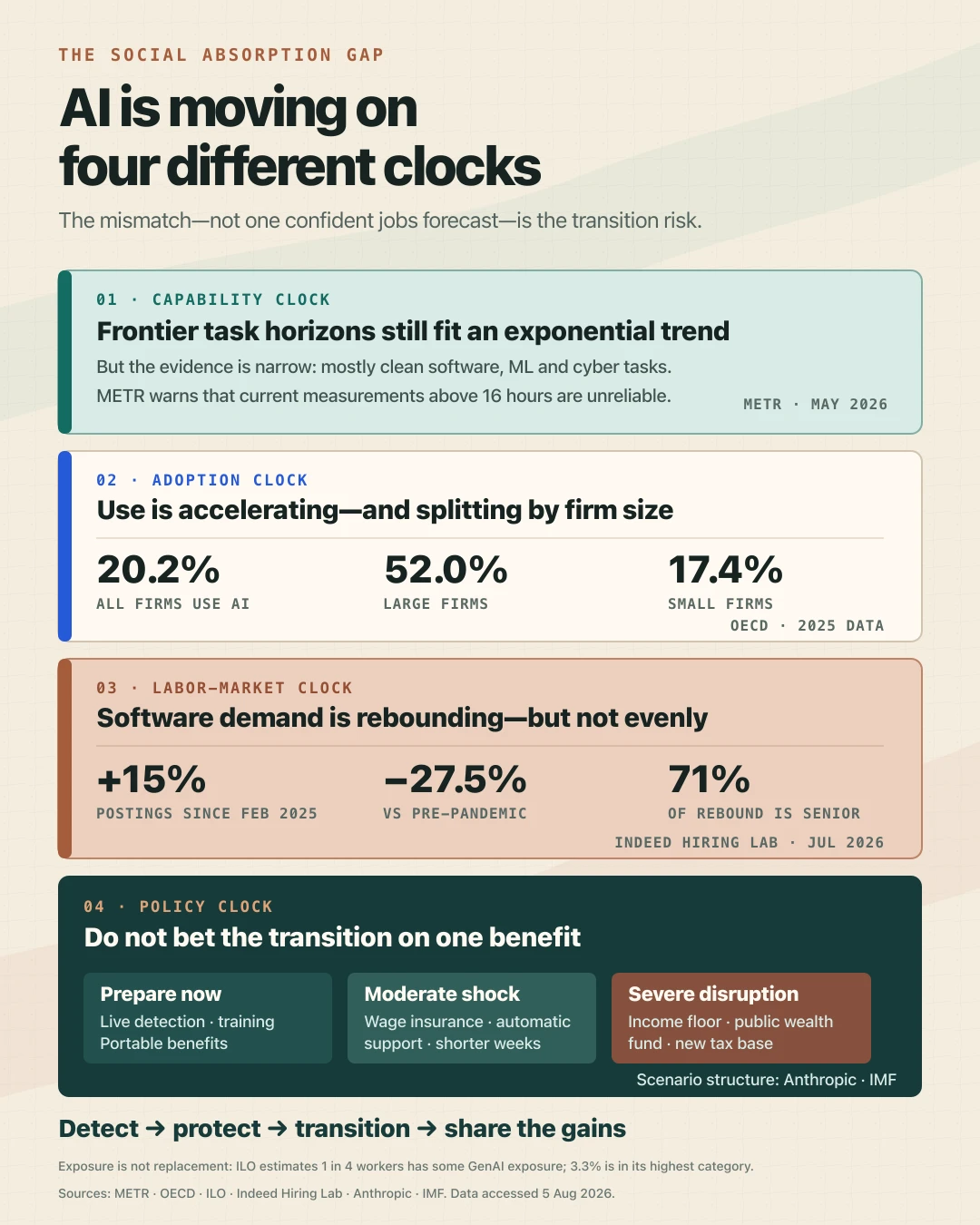
METR's current task-horizon measurements still show an exponential trend in the length of software, machine-learning, and cybersecurity tasks frontier agents can complete at a given reliability. METR is unusually clear about the limits: the tasks are comparatively clean and self-contained, most real jobs contain context and human interaction the benchmark does not capture, and measurements above sixteen hours are not yet reliable with the current suite.
Those caveats are not reasons to dismiss the trend. They are reasons to state it precisely. On tasks that suit agents, capability is extending rapidly. That does not mean whole occupations disappear at the same rate.
The adoption clock is slower and highly uneven.
OECD data published in January 2026 says the share of firms reporting AI use more than doubled from 8.7% in 2023 to 20.2% in 2025. But 52.0% of large firms reported using AI compared with only 17.4% of small firms. Even a broad “uses AI” measure therefore reveals a wide absorption gap before we ask whether the use is a chatbot, a coding assistant, or a redesigned production workflow.
The labor-market clock is noisier.
The ILO's refined global exposure index estimates that one in four workers is in an occupation with some exposure to generative AI, while 3.3% of global employment is in its highest-exposure category. Because most occupations contain tasks that still require human input, the ILO concludes that job transformation is the more likely broad effect than full replacement.
But transformation is not automatically gentle.
Indeed Hiring Lab's July 2026 analysis captures the ambiguity. US software-development postings had risen almost 15% since late February 2025 even as overall postings fell, but remained 27.5% below their pre-pandemic level. More importantly, 71% of the increase between May 2025 and May 2026 came from senior roles, while 37% came from jobs mentioning AI in the title, with overlap between the two.
That is not a clean story of destruction or creation.
It is a story of repricing. The market may want experienced people who can direct AI at the same moment that it weakens the junior roles through which experience is built. Employment can recover while the career ladder narrows.
The policy clock is the slowest because it has to act under uncertainty, across institutions that were designed for categories that AI is beginning to blur: employee and contractor, tool and worker, capital investment and labor substitution, temporary unemployment and permanent occupational change.
The clocks will not be made identical.
The practical goal is to stop their divergence from becoming socially destructive.
Basic Income Solves a Real Problem
Universal basic income is attractive because it answers a brutal question directly: what happens to a person's ability to live when the market no longer needs their current labor at the same price?
An unconditional income floor can reduce the penalty for a failed transition. It can give a worker time to retrain, care for someone, start a business, reduce hours, or refuse work on degrading terms. It is portable across employers and employment categories. In a labor market with more discontinuity, those are serious advantages.
The evidence also suggests that income security has value beyond job placement.
Finland's two-year randomized basic-income experiment paid 2,000 unemployed people €560 per month. The official evaluation found small employment effects, complicated in the second year by a simultaneous change in unemployment policy. Recipients nevertheless reported better economic security, life satisfaction, and mental wellbeing than the control group, although the evaluators cautioned against attributing every survey difference to the payment itself.
That is not a failure.
Reducing fear and administrative friction is a legitimate policy outcome. A person does not become economically safe only when a program increases measured employment.
But the experiment also clarifies what basic income does not do by itself.
It does not create a new entry-level profession. It does not make an employer invest in training. It does not preserve health coverage or pension accumulation in every system. It does not rebuild a region after its main source of work contracts. It does not give citizens ownership of the capital producing the gains. It does not ensure that a country consuming foreign AI services captures enough of the resulting economic rent to finance the dividend.
Basic income can provide a floor.
A floor is not a transition architecture.
The Risk Is Not Only Unemployment
The public debate is pulled toward a binary outcome because it is easier to discuss: either AI causes mass unemployment or it creates enough new work, as earlier technologies did.
The transition can be damaging without resolving into either extreme.
Imagine a labor market in which total employment remains healthy, but:
- junior knowledge-work roles become scarce;
- the wage premium flows to a smaller group able to supervise high-leverage systems;
- workers change occupation several times without portable benefits;
- small firms trail large firms in access to the productivity gains;
- tax revenue shifts away from labor more slowly than the income does;
- and communities far from AI capital centers buy the services without sharing much of the ownership upside.
That economy has jobs.
It may still have a legitimacy problem.
This is why the distribution question cannot be postponed until a national unemployment rate crosses an arbitrary line. By then, the damage may already be visible in weaker bargaining power, missing career ladders, household insecurity, and a concentration of wealth that is much harder to reverse than to prevent.
The object of policy should therefore be broader than replacing lost wages. It should preserve agency, mobility, participation, and a claim on the gains.
Build the Shock Absorbers Before the Crash
The right policy portfolio depends on the severity of the transition. That is not an excuse to wait. It is a design requirement.
Anthropic's economic-policy work organizes possible responses by scenario: workforce training and tax reform under modest disruption; adjustment assistance and automation-related taxes under moderate disruption; and sovereign wealth funds or new revenue structures in faster-moving cases. These are proposals for study rather than a company platform, but the contingent structure is useful.
The IMF staff discussion note on broadening the gains from generative AI reaches a similar conclusion from outside the labs: uncertainty about the nature, scale, and speed of the impact calls for an agile fiscal approach that can handle both ordinary adjustment and severe disruption.
A serious transition system would contain at least five layers.
1. Live labor-market detection
Governments need faster signals than periodic political debate.
Track vacancies, hiring by seniority, wage changes, hours, labor-force exits, benefit claims, occupational transitions, regional concentration, and the share of corporate income flowing to labor. Break the data down by age, gender, firm size, occupation, and geography.
Do not ask one number to prove that “AI took the jobs.” Use multiple signals to identify where the transition is becoming harder, then publish the thresholds that activate additional support.
2. Automatic continuity
People should not lose income, healthcare, pension contributions, or access to training every time their employment category changes.
Portable benefits, stronger unemployment insurance, wage insurance for workers who re-enter at lower pay, and income support that scales automatically with measurable displacement can cushion moderate shocks. If disruption becomes broad and persistent, a basic income or negative income tax can become a larger part of this layer.
The key is automaticity. A safety net that requires a new political battle after every model generation will always arrive late.
3. Training attached to real demand
“Reskilling” often means offering a course and transferring the risk to the worker.
Training should be connected to an employer, apprenticeship, professional pathway, or paid transition role. Employers currently have a stronger financial incentive to expense technology than to preserve and retrain the people whose work it changes. Anthropic's review includes proposals for employer training grants and tax changes that reduce this imbalance.
The metric should not be course completion.
It should be durable placement, wage recovery, and progression into work that still has a future.
4. New ways to share work
If AI raises output faster than demand for human hours, the choice should not be limited to layoffs or unchanged forty-hour jobs.
Shorter working weeks, phased retirement, job sharing, and more investment in labor-intensive public goods such as care, education, climate adaptation, and local infrastructure can distribute both time and participation more broadly. These options will not fit every sector, and they should be tested rather than romanticized.
The principle is what matters: productivity gains can be taken partly as time, not only as profit or unemployment.
5. A citizen claim on AI capital
If the largest gains accrue to model providers, compute owners, energy infrastructure, data assets, and the companies best able to reorganize around them, redistribution after the fact will be politically fragile.
A public wealth fund offers a different mechanism: society owns part of the productive capital and receives a return from it. The Alaska Permanent Fund shows the basic institutional pattern—a professionally managed public fund paired with a separate program that pays eligible residents—even though oil revenue and AI value are economically different.
The AI version could be funded through public equity stakes, auctioned access to scarce public resources, taxes on windfall rents, or a share of returns from publicly financed compute and energy infrastructure. The right instrument will differ by country.
The objective is consistent: do not finance an AI dividend only by taxing the shrinking side of the economy.
Readiness Is a System, Not a Mood
Optimists and pessimists are both tempted to make the same mistake.
They turn an uncertain transition into a confident endpoint.
The optimist says productivity will create new work, so intervention is premature. The pessimist says human labor is finished, so only universal income matters. Both positions skip the institutional work between the present and their forecast.
We do not know the final employment equilibrium. We know enough to see the clocks separating.
Capability is improving rapidly in domains suited to agents. Adoption is accelerating but remains uneven. Labor demand is changing in contradictory and seniority-biased ways. Public policy has a menu of plausible responses, but few are wired to activate with the evidence.
That is the work now.
Not choosing between complacency and UBI.
Building a transition system that can detect pressure early, keep people economically secure, create credible routes into new work, distribute time more fairly, and give the public a stake in the capital producing the gains.
The speed of AI may be outside the control of any one government.
The fragility of the transition is not.
Sources
- Tobias Zander's “We are not ready for the speed, and basic income is not the only answer” provides the argument this essay extends.
- METR's task-completion time-horizon research measures the capability trend and documents its important domain and reliability limits.
- The OECD's 2025 adoption data provides firm-use rates and the large/small-firm divide.
- The ILO's refined global exposure index estimates occupational exposure and distinguishes job transformation from full automation.
- Indeed Hiring Lab provides the US software-posting, seniority, and AI-title data.
- Finland's Ministry of Social Affairs and Health reports the final basic-income experiment findings.
- Anthropic's scenario-based policy review and the IMF staff discussion note outline contingent fiscal and labor-market responses.
- The Alaska Permanent Fund Corporation FAQ explains the governance split between the public fund and the resident dividend program.