

Two of the most revealing AI deals of the summer appear, at first, to be about different businesses.
On August 19, Stripe agreed to acquire OpenRouter, the gateway that gives developers one interface to hundreds of models and providers. Stripe's explanation was unusually direct: “Tokens are the central currency for companies building with AI.”
A week later, The Information reported that Nvidia had agreed to acquire Hugging Face for $12.9 billion. The transaction has not been publicly confirmed by either company. TechCrunch noted that another report still described the talks as unsigned and capable of falling apart.
That distinction matters. Stripe–OpenRouter is an announced agreement. Nvidia–Hugging Face remains a reported one, so any analysis of the second deal is necessarily conditional.
But the strategic pattern does not depend on the paperwork closing.
Stripe wants to control the layer that understands what intelligence costs and where demand should go. Nvidia has already been building the layer that organizes which open models run, on whose compute, in which jurisdiction. Hugging Face would give it the largest distribution surface in open machine learning and a gateway that can turn model discovery into paid inference.
One company is moving from money into token routing. The other may be moving from chips into model and compute routing.
Together, they point toward the next contest in AI infrastructure: not only who builds the best model or accelerator, but who becomes the trusted clearinghouse between demand and supply.
Tokens are not money, but they are becoming an economic unit
Stripe's currency language is directionally useful, but it should not be taken literally.
Tokens are not fungible in the way euros or dollars are. An input token and an output token can have different prices. A token consumed by one model is not economically equivalent to a token consumed by another. Models turn the same token budget into different levels of quality, latency, reliability, and business value. Tokens are neither a durable store of value nor a general medium of exchange.
They are closer to a metered unit of AI production.
That still makes them extremely important to Stripe. Every AI application has to translate a user action into some quantity of inference, then translate that inference into a price, a margin, and eventually a financial transaction. The token sits near the join between the technical system and the economic system.
Stripe had already moved toward that join before the acquisition. Its Token Billing product can synchronize model prices, record usage, apply a markup, and support credit packs, subscriptions, pure consumption pricing, or hybrid models. That solves the revenue side of an AI company's unit economics: how a business charges its customer for variable model usage.
OpenRouter supplies the other side.
According to its acquisition announcement, OpenRouter now processes more than 10 trillion tokens per day across more than 400 models for over 10 million developers and companies. It can route requests across providers based on cost, throughput, latency, reliability, data-retention policy, and regional requirements. Its provider-routing documentation shows how the platform continuously measures provider behavior and can select the cheapest, fastest, or lowest-latency option while preserving fallbacks.
Stripe therefore is not merely buying token volume.
It is buying a decision engine positioned directly in the cost of goods sold.
The combined system can potentially see both sides of an AI company's gross margin:
- what the customer was charged;
- what model and provider served the request;
- how many tokens and other resources it consumed;
- what the request cost;
- whether another route would have produced an acceptable result faster or more cheaply.
Traditional payments optimization decides which rail, authorization path, or fraud intervention gives a transaction the best chance of succeeding profitably. Token routing applies a similar logic before the economic event is complete: which combination of model and provider gives this task the best result under a price and reliability constraint?
That is why OpenRouter is a natural Stripe acquisition even though it does not look like a payments company. Stripe is extending its economic infrastructure from moving money after a decision to helping determine how computational spend is allocated before the charge is calculated.
Calling tokens a currency is provocative. Treating token flows as a programmable economic rail is the deeper strategy.
Hugging Face is more than GitHub for models
Hugging Face is often described as the GitHub of machine learning. The comparison captures its importance as a repository and collaboration layer, but understates the business Nvidia would be buying.
The Hub is a discovery system, a distribution network, a developer identity layer, a versioned artifact store, a compatibility surface, and an increasingly direct path to computation. Hugging Face's summer 2026 ecosystem review counted 2.96 million public model repositories, one million datasets, and 1.44 million Spaces. Its data also showed that a very small share of repositories accounts for almost all downloads, making ranking, search, defaults, and compatibility unusually powerful.
Most importantly for this thesis, Hugging Face already has a gateway.
Inference Providers lets developers call models through a common client while Hugging Face handles provider selection and routing. Its billing documentation describes centralized pay-as-you-go access to more than 200 models without requiring separate provider accounts. Providers can expose price and performance data that powers choices such as :fastest and :cheapest.
Hugging Face also sells dedicated Inference Endpoints, enterprise collaboration, private model and dataset hosting, Jobs, and compute-backed Spaces. It is already the place where an open model can move from artifact to evaluation to deployment.
That makes Hugging Face strategically valuable to Nvidia in at least four ways.
First, it is the primary demand-discovery surface for open models. Nvidia can learn which architectures, quantizations, runtimes, and workloads are becoming important before that demand is visible in hardware orders.
Second, it is a distribution channel for Nvidia's full stack: GPUs, CUDA, TensorRT, NIM microservices, NeMo tooling, reference architectures, and optimized models.
Third, it connects models to external inference providers. That creates an opportunity to direct workloads toward a network of Nvidia-powered capacity without requiring Nvidia to own every data center.
Fourth, it is a counterweight to vertically integrated closed-model companies. When OpenAI, Google, Amazon, and Anthropic design or commission their own accelerators, they reduce their strategic dependence on Nvidia. A diverse open-model ecosystem keeps the model layer fragmented and makes a broadly compatible compute platform more valuable.
The model repository is therefore not merely content. It is a map of future compute demand.
Nvidia does not need to become another hyperscaler
The simplest interpretation of a Hugging Face acquisition is that Nvidia wants to become a hyperscaler for open-weight models.
That is close, but it risks importing the wrong operating model.
AWS, Azure, and Google Cloud own and operate vast general-purpose cloud estates. Nvidia can occupy an equally important position without reproducing all of that. It can provide the hardware, networking, systems software, deployment formats, health telemetry, marketplace, and demand aggregation while partners own much of the land, power, and local customer relationship.
The company has already been assembling this federated model.
DGX Cloud Lepton connects capacity from Nvidia Cloud Partners, specialist AI clouds, and hyperscalers in one compute marketplace. Nvidia says the accompanying management software monitors GPU health and automates operational diagnosis. In Europe, Nvidia has described open models running on regional partner infrastructure and deployable as NIM microservices across on-premises and cloud AI factories. Its sovereign-AI partnerships similarly combine Nvidia's platform with local operators, data centers, governments, and enterprises.
Hugging Face could become the developer-facing control plane for that network.
The likely end state is not one pure strategy but a mix of three:
- Direct inference where it matters. Nvidia or Hugging Face can operate selected capacity for popular models, strategic customers, benchmarks, launch-day demand, or underused inventory.
- Federated inference through partners. Independent providers can contribute regional and specialized capacity while a common catalog, API, deployment format, and marketplace make them easier to consume.
- Sovereign and private AI factories. Governments and enterprises can run open models on infrastructure located inside their chosen jurisdiction while relying on Nvidia's hardware and software stack for compatibility and operations.
This is a different kind of hyperscaler: less a single global landlord and more an operating system, exchange, and certification layer for distributed AI factories.
It also addresses a practical financial problem. Compute demand is volatile by model, region, and time. Capacity is capital-intensive and slow to build. A platform that observes model popularity on Hugging Face, aggregates demand, and routes inference across participating operators can improve utilization without placing every asset on Nvidia's own balance sheet.
Owning the demand surface can make a distributed supply network behave like one cloud.
The sovereignty opportunity contains a neutrality problem
This strategy could materially improve enterprise sovereignty.
Open-weight models become useful to enterprises only when they are operable: packaged, optimized, evaluated, secured, monitored, and available on infrastructure that satisfies latency, residency, and procurement constraints. Hugging Face and Nvidia together could make the same model deployable through a public endpoint, a regional provider, a private cloud, or an on-premises AI factory.
That is a stronger offer than “download the weights and good luck.”
It could give enterprises a credible continuum:
shared inference → dedicated regional endpoint → private cloud → on-premises deployment
The common model artifact and compatible tooling would reduce the cost of moving along that continuum as sensitivity, scale, or regulation changes. That is a real contribution to operational and jurisdictional sovereignty.
But sovereignty is not simply running an open model on locally situated Nvidia hardware.
As I argued in AI Sovereignty Starts With the Ability to Switch Models, meaningful sovereignty includes the ability to substitute a model, operator, region, or policy without rebuilding the whole system. Ownership of the most important open-model hub by the dominant accelerator company would concentrate influence over discovery, optimization, compatibility, and deployment in one commercial stack.
The tension is unavoidable:
- tighter integration can make open models dramatically easier to operate;
- the same integration can privilege Nvidia-compatible runtimes and infrastructure;
- shared routing can increase portability between providers;
- the routing layer itself can become a new point of dependency;
- a global platform can enable local execution;
- policy, telemetry, billing, and control-plane data may still cross jurisdictions.
Hugging Face's value comes partly from being perceived as a broadly neutral home for models from competing labs, clouds, and hardware ecosystems. OpenRouter makes a similar promise of model and provider neutrality. Once a neutral intermediary is owned by a major participant in the market it organizes, neutrality stops being only a product principle. It becomes a governance requirement that customers and competitors will expect to verify.
Two control planes are emerging
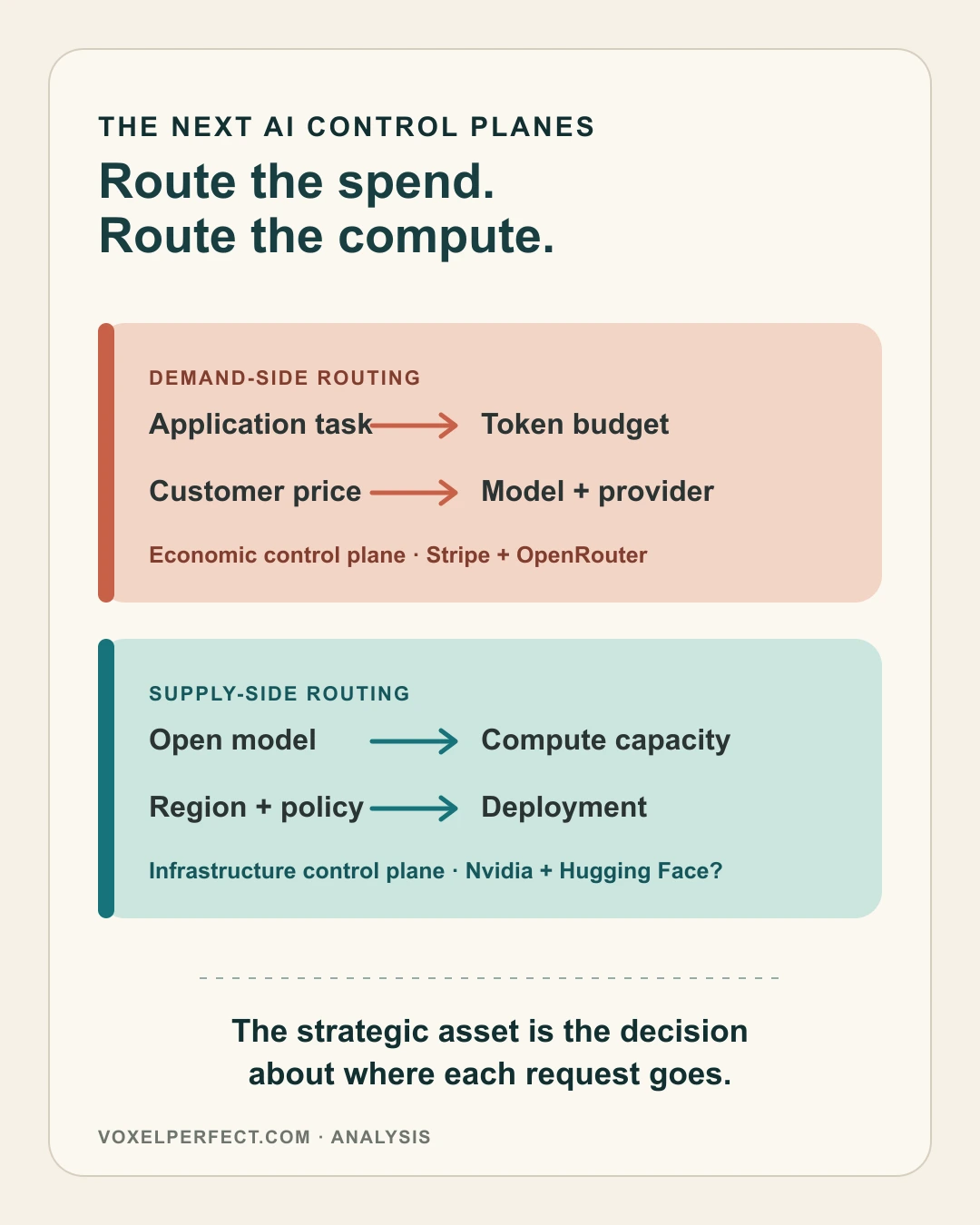
The Stripe and Nvidia moves are mirror images.
Stripe is approaching inference from the demand side. It can connect customer billing, usage credits, token prices, routing decisions, fraud, and margin. Its strategic question is: where should this unit of demand go to produce the best economic result?
Nvidia is approaching inference from the supply side. It can connect model artifacts, optimized runtimes, accelerator capacity, regional operators, private AI factories, and deployment policy. Its strategic question is: where should this model run to turn available compute into reliable intelligence?
These control planes meet on every request.
A future AI application may ask an economic router to choose the acceptable model and budget, then ask an infrastructure router to choose the provider, hardware, region, and deployment mode. In practice, the layers will overlap. OpenRouter already routes across providers. Hugging Face already centralizes inference billing. Stripe may influence cost-side routing, while Nvidia may influence which endpoints exist and how they perform.
The boundaries between payment processor, model gateway, repository, inference provider, and hardware platform are dissolving because they all mediate the same event: a request becoming computation, and computation becoming a charge.
The strategic asset is not the token itself.
It is the right to decide where the token is spent.
What enterprise buyers should require
The answer is not to avoid gateways. Few enterprises will operate every model-provider integration, benchmark every new release, and maintain regional capacity on their own. Aggregation creates genuine value.
The answer is to procure the control plane as infrastructure rather than treat it as an invisible convenience.
Make routing policy explicit
Define the allowed models, providers, jurisdictions, retention policies, price ceilings, latency thresholds, and fallback paths. Do not accept an opaque “auto” route for regulated or business-critical workloads. Require a reason code for each material routing decision and the ability to reproduce it later.
Separate model choice from provider choice
The best model for a task and the best place to run it are different decisions. Your architecture should be able to hold the model constant while changing providers, and hold the provider policy constant while changing models. Otherwise a gateway's convenience becomes architectural lock-in.
Demand credible exit paths
Keep prompts, evaluation suites, routing policy, usage records, and model artifacts exportable. Test a secondary gateway or direct-provider path before an incident. For open-weight models, verify that the exact weights, tokenizer, runtime configuration, and evaluation evidence can move to another operator.
Audit neutrality with outcomes, not promises
Measure whether routing systematically favors an owner's models, hardware, or capacity when alternatives perform better under your declared policy. Ask how rankings, defaults, sponsored placements, availability signals, and benchmark results are governed.
Put sovereignty in the whole stack
Data residency is not enough. Determine where prompts and outputs are processed, where telemetry and billing metadata are stored, who controls encryption keys, which remote management plane can affect the service, and whether local operations continue when the global control plane is unavailable.
Model both sides of the unit economics
Track revenue per task and contribution margin per successful outcome, not only cost per million tokens. A cheaper route that increases retries, review time, or customer churn is not economical. A more expensive model that completes a valuable task reliably may be.
The winning control plane will optimize for business outcomes, not token volume.
The next AI giants may own the intersections
The first phase of the generative-AI market rewarded model capability. The second rewarded access to accelerators and power. The next phase is concentrating around the intersections: the systems that translate intent into a model choice, a provider, a deployment location, a unit cost, and a customer charge.
Stripe's OpenRouter acquisition says that payments infrastructure is expanding upstream into the allocation of intelligence.
Nvidia's reported Hugging Face agreement, if confirmed, would say that compute infrastructure is expanding downstream into the discovery and distribution of models.
Stripe does not need tokens to become literal money. It needs them to become the standard meter through which AI businesses understand revenue and cost.
Nvidia does not need to own every data center. It needs open-model demand to resolve efficiently onto a broad, Nvidia-compatible network of data centers, inference providers, and sovereign AI factories.
One routes the spend. The other routes the compute.
The company that controls either route sees the market. The company that connects both sides may get to shape it.
Sources
- Stripe's OpenRouter acquisition announcement and Token Billing documentation explain its stated token-routing and AI-economics strategy.
- OpenRouter's announcement and provider-routing documentation document its scale, neutrality commitment, and routing controls.
- The Nvidia–Hugging Face transaction was reported by The Information; TechCrunch records the conflicting account and lack of company confirmation.
- Hugging Face's summer 2026 ecosystem report, Inference Providers documentation, and pricing and billing guide support the Hub and gateway analysis.
- Nvidia's materials on DGX Cloud Lepton and European sovereign-model deployment document its existing federated compute and AI-factory strategy.