

Gen Z is not rejecting AI.
It is using AI while trusting it less.
That distinction matters.
In a 2026 Gallup survey of 1,572 Americans aged 14 to 29, 51% said they used generative AI at least weekly, essentially unchanged from the previous year. Yet excitement about AI fell 14 percentage points to 22%, hopefulness fell nine points to 18%, and anger rose nine points to 31%. Anxiety remained high at 42%.
Curiosity was the most common response, at 49%.
This is not the profile of a generation that hates technology.
It is the profile of a generation that no longer confuses adoption with belief.
I think Gen Z may be the first post-naive-tech generation: the first cohort to enter adulthood after the costs of the digital economy became as visible as its benefits.
Earlier generations watched the internet move from frontier to infrastructure. We experienced search, social networks, smartphones and cloud software first as extraordinary new capabilities. Their business models, institutional effects and psychological costs became clear later.
Gen Z received the finished system.
The social feed was already optimized for attention. Personal data was already an industrial input. Online identity already carried social and professional consequences. Misinformation was not an edge case. Cyberbullying, algorithmic amplification, creator economics, surveillance advertising and platform dependency were not warnings about the future. They were features of the environment in which childhood took place.
Now AI arrives asking for trust.
Gen Z is entitled to ask what happened to the trust it gave technology the first time.
The end of technological innocence
“Digital native” has always been an incomplete description.
Growing up with a technology does not mean understanding who controls it, how it makes money, which behaviors it rewards or what it changes underneath the interface. Familiarity can make a system feel natural even when its incentives remain invisible.
Gen Z's difference is not that it possesses some innate digital wisdom. It is that technological innocence has become harder to sustain.
The evidence is visible in attitudes toward the platforms young people use most. In Pew's 2025 synthesis of its teen social-media research, 48% of U.S. teens said social media had a mostly negative effect on people their age, up from 32% in 2022. Forty-five percent said they spent too much time on it, while 39% said they felt overwhelmed by the drama they encountered there.
The same respondents also described real benefits. About three-quarters said social media helped them feel connected to friends, and 63% said it gave them a place to be creative.
That combination is more revealing than either side alone.
Young people can value a technology, depend on it, enjoy it and distrust the system around it at the same time. They do not need to resolve the contradiction because they live inside it.
AI intensifies the pattern. A nationally representative Common Sense Media survey found that 64% of U.S. teenagers did not trust major technology companies to care about their mental health and well-being, 62% doubted that those companies would protect safety when it conflicted with profit, and 47% had little or no trust that technology companies would make responsible decisions about AI.
Nearly four in ten teenagers who had used generative AI for schoolwork said they had already found a problem or inaccuracy in its output.
Skepticism did not arrive from a philosophy seminar.
The product taught it.
AI is both an advantage and a threat
Older technology debates often offered a comforting sequence: learn the new tool, become more productive, and benefit from the growth it creates.
Gen Z cannot assume that sequence will hold.
AI is being presented simultaneously as a required professional skill and as a system capable of absorbing the entry-level work through which professional skill is acquired.
Gallup found that 80% of Gen Z respondents considered it at least somewhat likely that AI would make it harder for them to learn in the future. Among employed Gen Z respondents, 48% said the risks of AI in the workforce outweighed its benefits; only 15% believed the benefits were greater. Sixty-nine percent trusted work completed without AI more than AI-assisted work, while 3% placed greater trust in work produced by AI alone.
Young people are not imagining the pressure on the first rung of the career ladder.
The Stanford Digital Economy Lab's August 2026 update on AI and employment found that employment among workers aged 22 to 25 in highly AI-exposed occupations was about 19% below where it would have been had it kept pace with employment in less-exposed occupations. The change appeared primarily in reduced hiring rather than increased dismissals, and experienced workers showed no comparable gap.
The researchers are careful: these are descriptive patterns, not proof that generative AI caused the entire divergence. Education, earlier trends and differences between datasets complicate the estimate.
But that caveat does not make the signal irrelevant to a graduate choosing a career.
For an established professional, AI may remove repetitive work and increase leverage. For somebody trying to become established, that same repetitive work may have been the apprenticeship.
The technology can be a ladder for the person already standing on the platform and a missing first step for the person below it.
It is rational for those two people to describe the same tool differently.
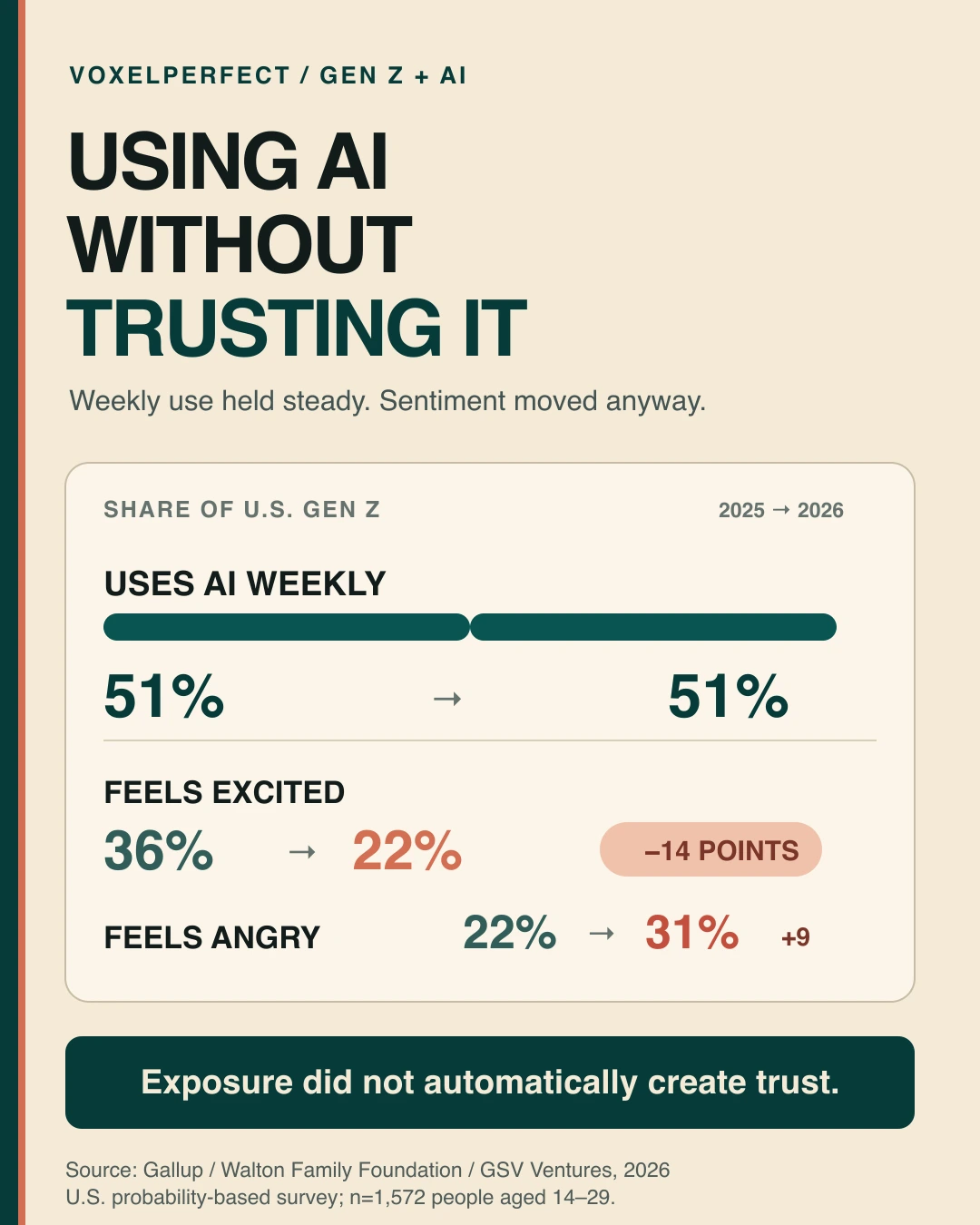
Original voxelperfect visualization based on the 2026 Walton Family Foundation, GSV Ventures and Gallup survey. The U.S. probability-based survey covered 1,572 people aged 14 to 29.
Education is sending a contradictory message
Schools and universities often tell students two things at once.
AI will be essential to your future.
Using it may invalidate your present work.
There are legitimate reasons to restrict AI in particular learning situations. Students need foundational knowledge. They need to experience the struggle through which an unfamiliar problem becomes an understood one. They need to demonstrate what they can do without assistance as well as what they can accomplish with it.
But institutions frequently provide rules before they provide a learning model.
Gallup found that the proportion of Gen Z K-12 students who reported having AI rules at school rose from 51% in 2025 to 74% in 2026. Yet only 28% said their school provided AI tools for schoolwork. Rules expanded much faster than institutional support.
That teaches a lesson, even when it is not the lesson the school intended.
It tells students that institutions recognize AI's power but have not decided how to help them use it well. It places responsibility on the learner while authority remains elsewhere. It may punish undisclosed assistance without teaching verification, model choice, disclosure, authorship or the boundary between productive support and displaced learning.
This is why punishing students cannot be an AI education strategy, and why one-mode assessment is no longer sufficient.
The task is not to make young people less skeptical.
It is to give their skepticism somewhere productive to go.
Abundant information has made certainty expensive
Gen Z also faces an information environment in which almost every claim arrives with a verification task attached.
The Reuters Institute's 2025 Digital News Report found that 58% of respondents across 48 markets were worried about distinguishing real from fake online news. Younger people were more likely to use social media comments and AI chatbots alongside traditional sources when checking information.
The report describes this as a flatter pattern of trust: instead of moving through a shared hierarchy of institutions, younger users assemble credibility across platforms, creators, comments, official sources, search results and increasingly AI.
There is capability in that behavior. It can expose a person to more perspectives and weaken the automatic authority of institutions that have not earned it.
There is also enormous cognitive cost.
When every source may be biased, every image may be synthetic, every expert may be performing for an audience and every confident answer may be generated, skepticism becomes a permanent background process. The mind does not merely consume information. It continuously triages authenticity, motive, context and risk.
Older generations were not necessarily more resilient. We often benefited from a smaller information surface and a more stable—if imperfect—set of validation institutions. We could be unaware of distant chaos or encounter it at a pace set by a daily newspaper and evening broadcast.
Gen Z receives the world's contradictions in real time.
The problem is not that young people know too much. It is that they are asked to validate too much without institutions they fully trust.
Skepticism alone is not protection
Calling Gen Z post-naive should not romanticize distrust.
Generalized skepticism can become its own vulnerability. If every institution is presumed corrupt, every source becomes equivalent. A polished creator, a viral comment and a peer-reviewed study can collapse onto the same plane. “Do your own research” can mean careful verification, but it can also mean selecting the evidence that feels most compatible with an existing identity.
The goal is not permanent suspicion.
It is calibrated trust.
That requires the ability to distinguish:
- a claim from its evidence;
- a model output from a verified result;
- institutional authority from institutional reliability;
- transparency from a performance of transparency;
- a useful tool from a system entitled to make the final decision;
- and personal control from a settings page that changes nothing important.
This is a richer form of AI literacy than prompt technique. It joins technical understanding with media literacy, domain knowledge, source evaluation, economic incentives and the confidence to stop using a system when its behavior no longer deserves trust.
What leaders should learn from the trust gap
Leaders can respond to Gen Z's skepticism in two ways.
They can treat it as resistance to be overcome.
Or they can treat it as information about what their systems have failed to prove.
The second response is more useful.
Demonstrate benefit at the level of the person
Productivity statistics at company level do not answer whether a worker gains skill, autonomy, income or opportunity.
Show who benefits, what improves, what new burden appears and how the result is measured. If AI saves four hours but increases surveillance, workload or responsibility without authority, the employee has not received a simple benefit.
Protect the path to competence
Do not automate every beginner task and then complain that new hires lack judgment.
Organizations need deliberate apprenticeship around AI: supervised practice, replayable work traces, opportunities to challenge outputs, access to experienced colleagues and responsibility that grows with demonstrated competence. Education needs the same architecture.
Make control real
People should be able to understand when AI is acting, inspect the important evidence, correct it, appeal a consequential decision, switch providers where practical and leave a system without losing their work or identity.
Trust grows from enforceable rights and operating choices, not reassuring language.
Invite young people into governance
Gen Z should not appear only as a risk category, customer segment or training problem.
The people living most intensely inside these systems can identify harms, norms and use cases that senior decision-makers will miss. Involve students and early-career workers in policy design, product testing, deployment reviews and decisions about which work should remain human.
Build for calm, not only engagement
The next generation of trustworthy technology should reduce the burden of constant verification. It should make provenance visible, uncertainty legible and important choices reversible. It should not require users to remain permanently alert in order to avoid manipulation.
That is not a request for less capable technology.
It is a request for more mature technology.
Trust is the product
Every generation is internally diverse. “Gen Z” is a demographic category, not a personality, and U.S. surveys cannot describe young people everywhere.
But the pattern across the evidence is hard to ignore.
Young people are adopting AI while becoming less optimistic about it. They are curious but anxious, capable but uncertain, dependent on digital systems but unwilling to grant them automatic legitimacy.
That is not a contradiction leaders should try to message away.
It is a verdict on the technological order Gen Z inherited.
The first era of consumer technology taught people to begin with possibility and discover the costs later. The next era will meet users who begin with the costs already in view.
AI companies, employers, educators and governments will not earn their trust by asking for more enthusiasm.
They will earn it by building systems that develop rather than hollow out capability; distribute rather than concentrate agency; make evidence easier to inspect; preserve meaningful choice; and remain answerable when they cause harm.
Gen Z does not need help believing in technology.
It needs technology worth believing in.
Sources
- The 2026 Voices of Gen Z study from Gallup, the Walton Family Foundation and GSV Ventures provides the adoption, sentiment, learning, workplace-trust and school-policy figures used throughout the essay.
- The 2026 Bentley University–Gallup Business in Society survey documents the sharp increase in AI skepticism and employment concern among U.S. adults aged 18 to 29.
- Pew Research Center's teen social-media findings supply the evidence on perceived harm, excessive use, overwhelm, connection and creativity.
- Common Sense Media's Teens, Trust, and Technology in the Age of AI provides the nationally representative U.S. evidence on teen trust in technology companies and experience with inaccurate AI output.
- The Stanford Digital Economy Lab's August 2026 employment update reports the widening descriptive employment gap for young workers in AI-exposed occupations and clearly states the study's causal limitations.
- The Reuters Institute's 2025 Digital News Report provides the cross-market findings on misinformation concern, verification behavior and younger audiences' flatter patterns of trust.
- Pew's 2026 research on how teenagers use and view AI adds evidence on awareness, confidence and teenagers' comparative judgments about AI in hiring, teaching and other human tasks.