

Anthropic has created a marketing event out of a compliance decision.
Its new Claude models will place an imperceptible watermark inside generated text and attach digitally signed provenance metadata to supported files. Anthropic says the marks will operate at the model level, survive copying and pasting in some circumstances and apply to supported Claude outputs worldwide.
The immediate reaction has not sounded like a celebration of transparency.
Some users are publicly saying they will leave Claude, often naming OpenAI as the destination. Others fear that a document merely proofread or translated by Claude could be treated as if Claude authored it. Developers are asking whether code will carry a mark. Writers are imagining employers, clients and educators using detection as an accusation machine.
There is not enough public evidence to call this an exodus. Social posts are signals, not subscription data. But the reaction is strategically important even before it becomes measurable churn.
It shows how a legal obligation shared by an entire market can be experienced as a defect in one product.
The Law Did Not Ask for Magic
Anthropic is responding to Article 50 of the EU AI Act. It requires providers of systems that generate synthetic text, audio, images or video to make outputs machine-readable and detectable as artificially generated or manipulated.
The important qualification appears in the same provision. The technical solution must be effective, interoperable, robust and reliable as far as technically feasible, taking account of the medium, implementation cost and the generally acknowledged state of the art.
That language matters because text watermarking is not a solved identification problem.
The 2024 ICML paper Watermarks in the Sand, shown in the image that prompted this article, proved an impossibility result for a strong class of generative-model watermarks under specified assumptions. Its attack removed the tested statistical signals with only minor quality degradation. The conclusion was not that every watermark is worthless. It was that providers should not promise an indelible proof that survives a capable adversary while preserving the output.
The law accommodates that limitation better than many headlines do. Article 50 does not say that a watermark must settle authorship beyond doubt. It asks providers to implement the most credible machine-readable marking the technology can support.
That can still be useful.
A provenance signal may help a platform identify synthetic media at scale, help a newsroom inspect the origin of a file or help a model provider prevent its own outputs from flowing back into training data unnoticed. It does not need to be invincible to improve a larger detection system.
The problem begins when a probabilistic signal acquires the social authority of a verdict.
A Claude Mark Does Not Mean Claude Wrote It
Anthropic's own guidance on marking AI-generated content draws an unusually important boundary.
A detected mark is a signal that content may have been processed by Claude. It is not conclusive proof of full provenance. Claude may have proofread, translated, summarized or reformatted material that a person substantially authored. Conversely, the absence of a detected mark does not prove that Claude was never involved. Short outputs, edits and transformations can weaken detection.
That is a technically responsible caveat. It is also a marketing problem.
Users do not buy a statistical mechanism. They imagine the person who will interpret it.
A communications professional imagines a client asking why a human-written release carries an AI signal after a grammar pass. A student imagines an instructor treating detection as proof of cheating. A developer imagines a code review or procurement scan collapsing assistance, authorship and licensing into one label.
The user's fear is not simply, “Will the watermark survive?”
It is, “What will someone conclude about me if it does?”
That distinction explains why a technically limited mark can create a commercially significant reaction. The risk is not embedded only in the text. It is produced by the institution reading the text and the power it has over the author.
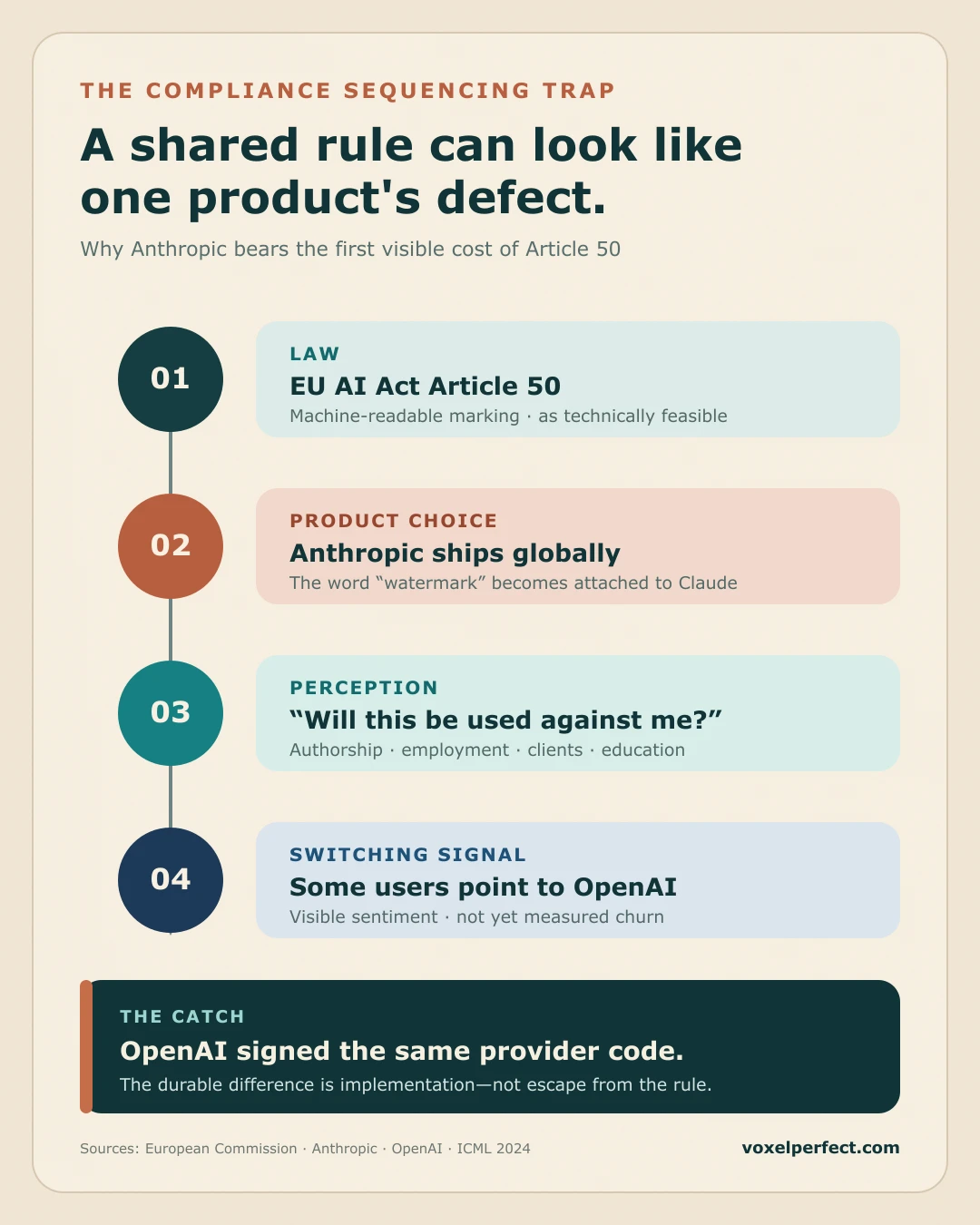
Anthropic Is Paying the First-Mover Compliance Tax
The EU rule applies across the category, not only to Anthropic.
The European Commission's list of signatories to the transparency code includes Anthropic, OpenAI, Google, Meta, Microsoft and Mistral in the provider section. The voluntary code offers a recognised route to demonstrate compliance; the underlying Article 50 duty is legal.
Yet implementation will not arrive everywhere at the same time or in the same form.
Anthropic has made its text watermark concrete, global and easy to associate with Claude. OpenAI's current public provenance stack is more visible in images and audio. It combines C2PA Content Credentials, SynthID watermarks and verification tools, while explicitly warning that no detection method is foolproof.
For a user making a decision today, that difference in visibility can feel like a difference in obligation.
This is the first-mover compliance tax: the company that operationalizes a shared rule first becomes the company most closely identified with its cost.
The dynamic is not unique to AI. Privacy controls, safety prompts, age checks and fraud reviews can all make the most visible implementer feel more restrictive than competitors that face the same underlying pressure but have not yet exposed the mechanism.
The market temporarily compares a shipped constraint with an unshipped promise.
That is why movement toward OpenAI is meaningful from a marketing perspective even if it remains anecdotal. It reveals where users currently locate the cost. Claude is the product that made the mark tangible, so Claude receives the blame.
But it would be a mistake to present OpenAI as a permanent watermark-free refuge. OpenAI has signed the same provider code and, in a statement reported by TechRadar, says it intends to expand provenance across modalities, including text, as standards mature. The durable difference will be in implementation, accuracy, user control and communication—not whether a major provider can ignore Article 50 indefinitely.
OpenAI Already Knew This Could Move Users
The competitive risk was visible before the EU rules became applicable.
In 2024, The Wall Street Journal reported on OpenAI's internal debate over text watermarking. Nearly 30 percent of surveyed ChatGPT users reportedly said they would use the product less if OpenAI deployed a watermark and a rival did not. Sixty-nine percent believed cheating-detection technology could produce false accusations.
Those results were not a prediction of what users would actually do in 2026. They measured stated intent in a different product and regulatory context. But they identified the same marketing structure now surrounding Claude.
Watermarking is welcomed in the abstract and resisted at the point of personal exposure.
People want synthetic political media identified. They want fraud, impersonation and mass-produced deception constrained. They are less enthusiastic when the same infrastructure could classify their own assisted work, especially when detection cannot distinguish the writer from the tool that touched the prose.
OpenAI's short-term advantage is therefore partly an advantage of sequence. It can observe Anthropic's backlash, refine the story and choose how visibly to attach the mechanism to the product.
That is valuable, but it is not free.
If OpenAI benefits from users who believe ChatGPT will remain unmarked while preparing its own compliance path, the eventual announcement could feel like a bait and switch. Silence can acquire the meaning of a promise even when a company never made one.
The Marketing Failure Is an Information-Order Failure
Anthropic's guidance contains many of the right facts. The order in which the market received them is the problem.
“Claude will watermark text” travelled faster than the explanation that detection is not conclusive. The mark became real before a public detector and detailed technical documentation were available. The global scope was clear before the practical boundaries for proofreading, translation, code and short outputs were easy for ordinary users to understand.
In product marketing, sequence changes meaning.
If users hear “watermark” first, they import familiar associations: ownership stamps, plagiarism detectors, surveillance and proof of guilt. Later caveats look like damage control.
The stronger launch sequence would have started with the user's risk model.
Anthropic could have led with four promises:
- A mark is evidence of processing, not proof of authorship or misconduct.
- The verifier will report uncertainty and limitations, not a binary accusation.
- Assisted work and wholly generated work require different interpretations.
- Other major providers face the same European duty, even if their implementations differ.
Only then should the company have explained the technical mechanism.
The detector matters too. Shipping a mark before people can inspect how it is detected creates an information imbalance. The provider can tag the output; the user cannot yet test what a client, school or platform might see. Even a temporary gap makes the system feel like control exercised over the customer rather than infrastructure built for the customer.
Provenance Has to Give Users Something Back
The long-term marketing opportunity is larger than avoiding backlash.
Provenance can become a product benefit if it works reciprocally.
Imagine a writer receiving a record that distinguishes original material, Claude-assisted edits and imported source text. Imagine a company being able to verify which approved model touched a document without sending that document to a third-party detector. Imagine a designer carrying signed edit history across tools while retaining attribution and licensing information.
In those cases, provenance protects the user as well as the information ecosystem.
That is a better promise than “we can detect our model's output.” It says: “we can help you demonstrate how the work was made.”
OpenAI's layered approach points in this direction for media. Content Credentials can carry richer context; a watermark can survive when metadata disappears; a verification tool can interpret both. The system is still imperfect, but the architecture recognises that no single mark should bear the whole burden of trust.
Text needs the same restraint.
The correct unit is not an accusation attached to a paragraph. It is a chain of evidence with known limits, presented to people who understand what each signal can and cannot establish.
Regulation Creates a Floor, Marketing Creates the Difference
The EU AI Act has placed provenance on the product roadmap of every serious generative-AI provider serving Europe.
That does not commoditize the response.
One company can make compliance feel like protection. Another can make the same duty feel like surveillance. One can describe a probabilistic signal with calibrated language. Another can let “watermark” become shorthand for authorship. One can give users verification, export and appeal mechanisms. Another can ask them to trust a detector they cannot yet inspect.
Anthropic's announcement is therefore a blog-post opportunity because it connects three debates that are usually separated.
The research shows why strong watermarking claims must be modest. The EU AI Act shows why limited technical measures may still be required and useful. The early user reaction shows why implementation is inseparable from brand.
People moving toward OpenAI are not only choosing a model.
They are choosing what they believe the model will imply about them.
That belief may prove temporary when competitors reveal their own compliance systems. But temporary beliefs move attention, subscriptions and market narrative in the present.
The winner will not be the company that pretends provenance can be avoided.
It will be the company that makes provenance credible without making legitimate users feel accused.
Sources
- Anthropic's content-marking guidance documents the worldwide scope, model-level text watermark, signed file metadata, planned detection support and the limitations on what presence or absence of a mark can establish.
- The European Commission's Article 50 guidance, Code of Practice and signatory list establish the legal duty, technical-feasibility qualification, provider/deployer distinction and market-wide participation. The official regulation remains the authoritative legal text.
- Zhang et al., Watermarks in the Sand, Proceedings of ICML 2024, supplies the impossibility result and demonstrated attacks discussed here. It does not establish that every limited provenance signal is useless.
- OpenAI's content-provenance announcement and EU AI Act guidance document its layered use of C2PA, SynthID and verification tooling and its caution that provenance signals can fail or be removed.
- TechRadar's report on Anthropic's implementation contains OpenAI's statement that it aims to extend provenance signals to text. That is a stated goal, not evidence that OpenAI has already deployed text watermarking.
- The Wall Street Journal's 2024 report on OpenAI's text-watermark debate supplies the reported user-survey figures. Current claims of Claude-to-OpenAI switching remain anecdotal; public reactions such as the highly visible Claude discussion show sentiment, not measured churn.