

Jensen Huang has declared that AI compute is becoming an investable asset class.
He is right about the direction of travel.
He is too generous to the chip.
In NVIDIA AI Factory Compute Is Becoming an Investable Asset Class, Huang describes new partnerships with Apollo, BlackRock, Blackstone, Brookfield, Goldman Sachs and KKR. The proposed financing platforms are designed to mobilize more than $500 billion of third-party capital for AI infrastructure over time.
The headline sounds like Wall Street has decided that racks of GPUs belong beside toll roads, power plants and fibre networks in the infrastructure portfolio.
That is not quite what has happened.
NVIDIA has signed memorandums of understanding for platforms that still require final agreements and project-by-project underwriting. The $500 billion is not one committed fund, NVIDIA revenue or financing promised to one customer. Huang says the institutions will independently evaluate customer credit, demand, utilization, cash flow and residual value.
Those qualifications contain the real story.
AI compute becomes an investable asset only when a much larger system makes its cash flows underwritable. The GPU is collateral. The asset is the contract stack around it.
What NVIDIA Is Actually Announcing
The NVIDIA announcement describes dedicated pools of institutional capital that could finance NVIDIA-based AI factories at “attractive rates.” It presents NVIDIA compute as productive infrastructure with four unusually valuable properties:
- it can serve many customers and workloads;
- CUDA and the surrounding software ecosystem improve its productivity;
- the same architecture can be transferred among operators;
- a deep population of potential users may support residual value.
Huang uses the A100 as evidence. Released in 2020, it remains commercially active six years later. He also cites rising rental prices for H100 capacity and premiums for Blackwell systems as evidence that older and newer NVIDIA compute can generate durable revenue.
The argument is not that a GPU appreciates like land.
It is that a standardized computing platform can keep producing saleable output after its first customer or initial depreciation schedule has ended.
That matters to lenders. A specialized machine with one buyer and no secondary use is difficult collateral. A cluster that can be reassigned across language models, scientific computing, media, robotics and inference has a larger recovery market.
But even this stronger form of the argument does not make the hardware independently financeable.
The lender still needs to know who will pay to use it.
The Financeable Unit Is a Stack
An AI factory combines several assets with very different risk profiles.
The physical layer is land, grid access, generation, cooling, networking and a building able to support dense systems. Power availability may have a longer economic life than any installed accelerator.
The computing layer is the GPU, CPU, networking fabric, memory, storage and systems software. It has high initial value and unusually fast technical turnover.
The platform layer is CUDA, libraries, orchestration, developer skills and compatibility with customer workloads. This layer is why an NVIDIA cluster may be easier to reassign than an otherwise capable but less widely supported system.
The contract layer is the take-or-pay agreement, reserved-capacity commitment, prepayment or usage history that converts possible demand into forecast cash flow.
The credit layer is the guarantee, residual-value support, equity cushion, insurance or restricted cash that decides who absorbs loss when the forecast is wrong.
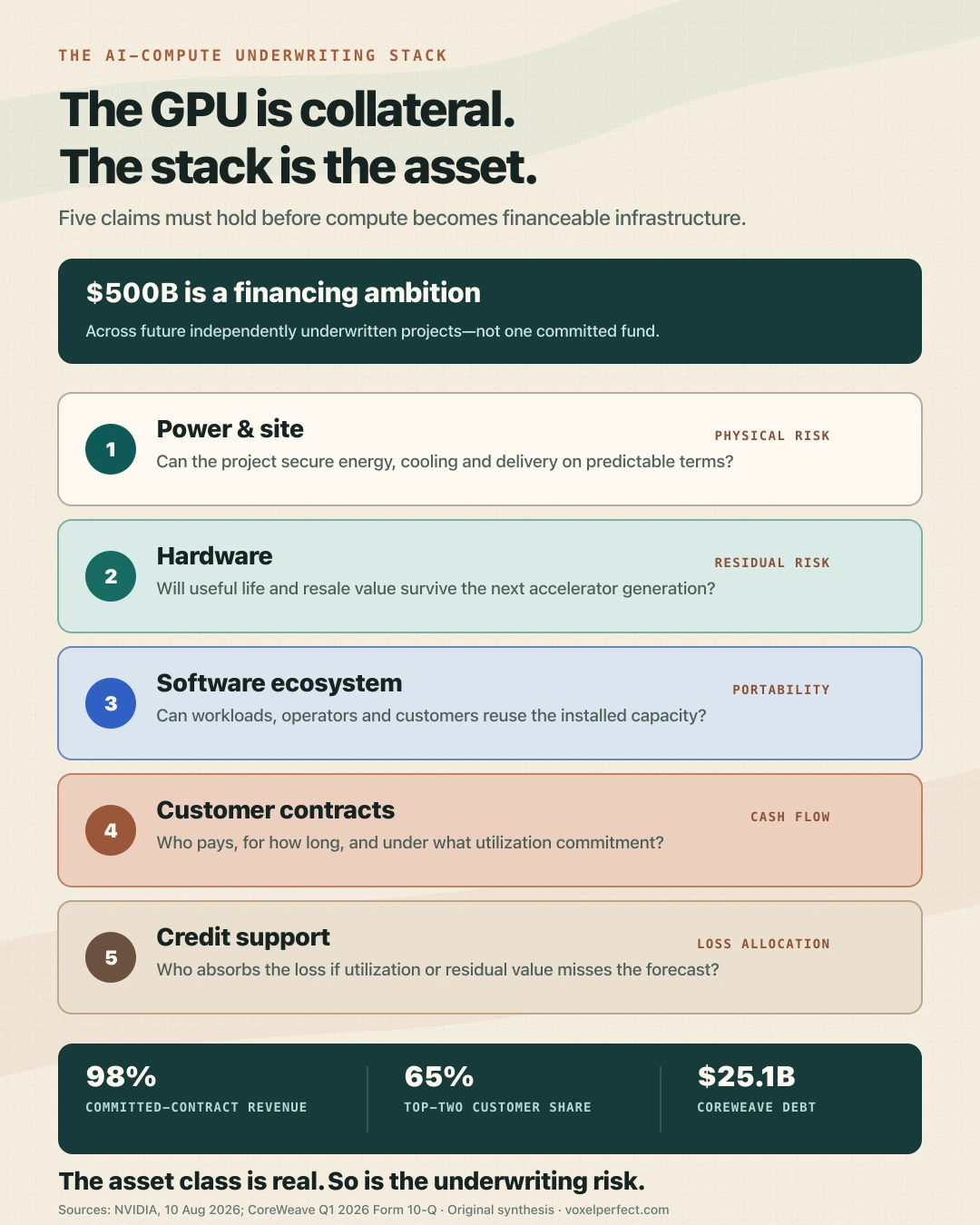
Calling the whole structure “compute” is commercially convenient. It makes the factory sound like one standardized asset.
For underwriting, the distinctions are essential. A lender can believe that AI demand will grow and still reject a project with weak power economics, concentrated customers, a short contract or an aggressive residual-value assumption.
CoreWeave Shows What Lenders Already Underwrite
This asset class is not theoretical. CoreWeave has already built a large financing machine around contracted GPU capacity.
Its first-quarter 2026 filing reported $25.1 billion of principal debt, $10.1 billion of operating lease liabilities and $36.4 billion of net property and equipment. The debt did not price like a mature regulated utility: listed effective rates ranged from 7% to 15% across major facilities and notes.
The structure nevertheless looks increasingly like project finance.
CoreWeave says its delayed-draw facilities are collateralized by project assets and pledged contractual cash flows, generally from investment-grade counterparties. A new $8.5 billion facility sizes debt using the depreciable cost of eligible computing equipment, projected debt-service coverage and project-level conditions. It also requires interest-rate hedging, power-cost hedging and restricted cash.
That is not a loan made because “compute is revenue.”
It is a loan made because a defined project combines equipment, customer obligations, hedged inputs and controls around cash.
The filing also reveals where the risk concentrates:
- committed contracts generated 98% of first-quarter revenue;
- the top two customers generated about 65% of revenue;
- customers have contractually specified NVIDIA GPUs;
- the company warns that useful-life estimates may be wrong and that older infrastructure may not be redeployable;
- failed customers could leave CoreWeave with capacity, equipment, leases and financing costs but no corresponding revenue.
These are precisely the variables Huang says institutional investors will assess independently.
The evidence supports his central claim: AI compute is becoming financeable.
It also shows why the asset cannot be reduced to the chip.
Residual-Value Support Changes the Meaning of “Independent”
The most consequential sentence in Huang's essay is not the $500 billion figure.
It is his statement that NVIDIA may provide residual-value support for up to 25% of an opportunity in some cases.
That support could make a project easier and cheaper to finance. If the equipment is worth less than expected at the end of a contract, a defined NVIDIA mechanism may absorb part of the shortfall. The lender can rely less heavily on an uncertain resale market.
It also puts NVIDIA's balance sheet behind demand for NVIDIA's products.
Independent institutions may make the lending decision, but the vendor is still helping shape the downside. This does not automatically make the financing circular or artificial. Vendor finance has long helped buyers acquire aircraft, industrial equipment, vehicles and telecommunications systems.
The correct question is not whether the transaction forms a circle.
It is what holds the circle up.
If customer cash flows comfortably support the debt and NVIDIA's protection covers only a remote residual risk, the vendor support improves an otherwise productive project. If the project's economics depend on the vendor repeatedly protecting used equipment values while also selling the next generation, the support may be manufacturing financeability.
The distinction will be visible in final terms: loan-to-value ratios, customer concentration, contract duration, performance triggers, recovery rights and how often NVIDIA's support is expected to be used.
Financing Is Becoming Part of the Compute Product
NVIDIA is not entering this market from a neutral position.
It benefits when more customers can buy NVIDIA systems. It benefits again when those systems increase CUDA adoption and software demand. In a separate July programme, NVIDIA said it would combine credit support and revenue sharing with AI clouds, earning standard product revenue plus a share of cloud revenue from supported capacity.
This is the GPU counterpart to the structure examined in Google's $44 Billion TPU Backstop. Google uses its credit to help third-party projects build capacity around Google TPUs. NVIDIA is assembling institutional capital, platform standardization and selective residual-value support around NVIDIA systems.
The competitive unit is no longer the accelerator.
It is the accelerator plus software, power, customer distribution and cost of capital.
That has two opposing effects.
More financing can widen access to scarce compute and create independent operators that compete with the hyperscalers. It can let an AI cloud turn a signed customer contract into capacity without funding an entire cluster from expensive equity.
It can also accelerate construction faster than end demand becomes diversified. When several projects rely on the same vendor, a small group of customers and similar residual-value assumptions, individually independent loans can become collectively correlated.
Capital diversification is not the same as risk diversification.
Five Questions for the New Asset Class
Before calling an AI factory infrastructure, ask five questions.
- Who pays for the output? Is demand supported by creditworthy take-or-pay customers, volatile spot rentals or a forecast of future token usage?
- What survives the next hardware generation? Can software improvements preserve competitive economics, or will a new platform make the installed system expensive to operate?
- How transferable is the factory in practice? Redeployment requires compatible power, networking, software, security and customer workloads—not merely a movable rack.
- How concentrated are the cash flows? A multi-tenant label means little if two customers supply most revenue.
- Who owns the residual-value loss? The operator, lender, customer and vendor can all appear protected until the contracts are read together.
These questions do not disprove the asset class.
They define it.
The Asset Class Is Real. So Is the Underwriting Risk.
Huang is describing a genuine phase change.
AI infrastructure is moving from opportunistic equipment loans and hyperscaler balance sheets toward repeatable project vehicles, long-duration contracts, private credit and institutional infrastructure capital. That can lower financing costs, broaden ownership and turn expected AI demand into operating capacity sooner.
But the phrase “compute is revenue” skips the most important work.
Compute is potential output. Revenue appears only when a customer values that output, a contract captures the value, the operator keeps the system utilized, power remains available and the platform stays competitive long enough to repay the capital.
The GPU makes the project possible.
The contract stack makes it investable.
Sources
- Jensen Huang's NVIDIA AI Factory Compute Is Becoming an Investable Asset Class provides the asset-class argument, A100 and rental-price examples, explanation of the $500 billion figure, independent-underwriting framework and potential NVIDIA residual-value support.
- NVIDIA's partnership announcement documents the six financial institutions, memorandums of understanding, proposed capital platforms and forward-looking status of final agreements.
- NVIDIA's AI-cloud financing model documents its separate use of credit support and revenue sharing to expand AI-factory capacity.
- CoreWeave's Q1 2026 Form 10-Q provides the debt, leases, property, customer concentration, contracted-revenue, project-finance, hedging, useful-life and redeployment disclosures used in the underwriting analysis.
- Axios's same-day report provides independent context on the scale of the proposed platforms and renewed concern about circular financing.