

Elon Musk says money will not matter in 2036.
Sam Altman says it will.
I think Altman is closer to the truth—not because Musk's economic mechanism is absurd, but because it stops one layer too early.
In The Economist's interview clip, Musk makes the clean version of the argument. We want money because it buys goods and services. If AI and robots can produce more goods and services than people could consume, the scarcity that gives money its purpose disappears. Work becomes optional, output becomes abundant, and money becomes less relevant.
Zachary Lynde's post places that prediction beside Altman's opposing view: money will still matter, and AI may concentrate wealth and power rather than dissolve them. Lynde's sharpest point is that intelligence can become abundant while a small number of companies still own the tap.
That is the distinction that matters.
Abundant production does not automatically create abundant access.
Musk is describing what may happen to the cost of labor. Altman is asking who owns the systems, infrastructure, and rights around it. The first is a production question. The second is an allocation question.
The future will be shaped by both.
Musk Is Right About One Important Mechanism
Money buys labor indirectly through almost everything.
Food contains agricultural, logistics, retail, and administrative labor. Housing contains design, permitting, construction, finance, maintenance, and insurance labor. Transport contains manufacturing, operation, energy, and repair labor. Software and entertainment contain cognitive and creative labor.
If capable AI makes cognitive work extremely cheap, and general-purpose robots do the same for physical work, the cost structure of much of the economy changes. Standardized services could approach the marginal cost of compute. Manufactured goods could become cheaper as design, production, inspection, and logistics automate together. Some categories may become so plentiful that charging for each unit makes little sense.
Musk is also right that this can be deflationary. If the supply of useful output grows faster than demand, prices can fall. The same amount of money can buy more.
That is not a minor possibility. It is one of the central promises of AI.
But lower prices are not the same as no scarcity, and no scarcity is not the same as no allocation system.
Money Does More Than Buy Labor
The Federal Reserve Bank of St. Louis describes money through three functions: a medium of exchange, a unit of account, and a store of value.
Those functions are useful wherever people need to compare claims, coordinate exchange across time, or decide who gets access to something limited.
Labor is one source of limitation. It is not the only one.
Even in a world of highly automated production, people may still compete for:
- energy at a particular time and place;
- frontier compute with guaranteed latency and reliability;
- land in desirable locations;
- scarce minerals and manufacturing capacity;
- trusted healthcare and physical safety;
- human attention, care, reputation, and relationships;
- priority during emergencies or supply shocks;
- ownership of the systems producing the abundance;
- and influence over the rules those systems follow.
Automating construction does not manufacture more coastline or put every home beside the best school. Automating medicine does not make every scarce treatment, organ, or clinician's attention simultaneously available. Making inference cheaper does not guarantee equal access to the best model, the fastest service tier, or the energy needed to run it.
Money could become less important for a basket of basic goods and remain decisive for everything that preserves choice, status, resilience, and control.
That would not be a post-money economy.
It would be an economy in which money buys less labor and more priority.
Abundance Moves Scarcity Upstream
Every layer of abundance rests on another layer that can become a bottleneck.
Cheap AI services depend on chips, data centers, cooling, grids, networking, and energy. Cheap robotic labor depends on minerals, factories, batteries, maintenance, land, and physical infrastructure. The more downstream production scales, the more pressure it can place on these upstream systems.
The International Energy Agency's work on energy and AI reported that global data-center electricity demand grew by 17% in 2025. Its broader analysis notes that AI-focused facilities can draw power comparable to energy-intensive factories while being much more geographically concentrated.
That is abundance's recurring pattern.
One constraint falls. Demand expands. The next constraint becomes visible.
Software made distribution cheap, then attention became scarce. Cloud computing made servers easier to rent, then accelerator access and energy became strategic. AI may make many forms of labor abundant, then ownership, reliable capacity, and permission become more valuable.
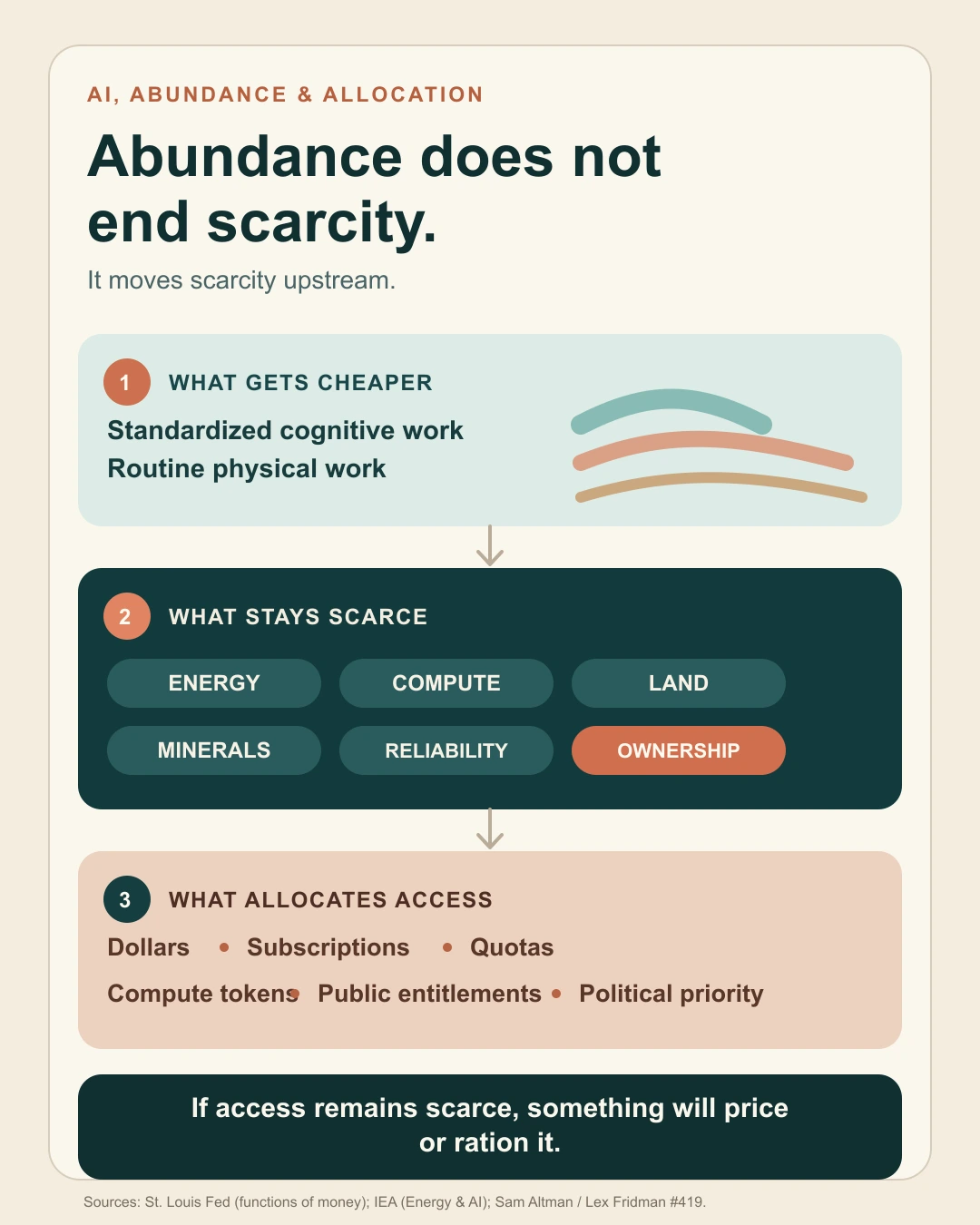
This is why the debate cannot end with “robots will make everything.”
The question is what those robots require, who owns them, and how their output reaches everyone else.
Automated Labor Will Not Be One Uniform Commodity
“Robot labor” sounds singular. It will not be.
There will be tiers of capability, reliability, safety, speed, embodiment, and autonomy. A low-cost system may handle predictable household work. A more capable one may operate industrial equipment. Another may perform regulated or high-consequence tasks under strict guarantees. Some will be owned outright. Others will be metered, geographically restricted, licensed, or available only inside an integrated platform.
AI already works this way.
The cheapest model is not always the most capable. The most capable model is not always available with the lowest latency, strongest privacy, largest context, or highest service guarantee. “Intelligence is abundant” can be true at the category level while the particular intelligence needed for a particular decision remains expensive.
Robotics will add physical constraints to the same tiering: payload, dexterity, battery life, maintenance, certification, insurance, and access to replacement parts.
If automated labor arrives in differentiated tiers, prices will not simply vanish. They will express those differences.
AI Tokens Would Be Money in Another Costume
The replacement may not always be called money.
It could be compute credits, energy quotas, priority points, platform tokens, or a guaranteed allocation of robotic hours. Altman has explicitly entertained this direction. In a 2024 conversation with Lex Fridman, he called compute “the currency of the future” and immediately identified energy, data centers, supply chains, and chip fabrication as the hard constraints around it.
Imagine that every citizen receives an annual allowance of AI compute.
If the allowance can be used, saved, donated, or sold, it begins to perform the classic functions of money. It measures access. It stores a claim for later. It can be exchanged with someone who values the resource more.
If it cannot be traded, it is still a rationing system. Someone must decide the allocation, the permitted uses, the expiration rules, and whether a person can buy more.
The label changes.
The political question does not.
Who gets how much of the scarce capacity, on what terms, and with what right of appeal?
Money is one answer. A token is another implementation. A public entitlement, queue, lottery, or administrative priority is another. None abolishes allocation.
Altman Is Closer on Power
Altman is not an abundance skeptic.
His 2021 essay “Moore's Law for Everything” argued that AI could create extraordinary wealth and drive down the cost of many goods. But his essay “American Equity” states the other half plainly: the default path of automation is to concentrate wealth, and therefore power, in very few hands.
That is the part of Musk's utopia I find least convincing.
Technology can reduce material scarcity. It does not automatically reduce the human desire for relative advantage, influence, security, status, or control. History gives us little reason to expect the owners of a powerful production system to surrender those advantages simply because the system can make more things.
This is not only a judgment about individual billionaires. It is a structural point.
When automated systems replace work, income can move away from labor and toward the owners of capital. The IMF's analysis of generative AI and work warns that higher capital returns can increase wealth inequality even as productivity rises. Its fiscal-policy work therefore argues that tax and social-protection systems may need to adapt as labor's share of income comes under pressure.
An economy can produce more than ever and distribute control more narrowly than ever.
That is abundance without agency.
2036 Is a Transition Horizon, Not a Post-Scarcity Deadline
Musk's ten-year claim also compresses several revolutions into one date.
Frontier AI must become dependable across a much broader range of work. Robotics must move from impressive demonstrations into enormous volumes of safe, dexterous, maintainable machines. Energy, chips, factories, grids, and supply chains must scale with them. Organizations must redesign operations. Law, insurance, liability, taxation, and public institutions must adapt. The resulting gains must reach households rather than remain mostly inside asset values and corporate margins.
Any one of those transitions would be substantial.
Together, they make 2036 a useful provocation but a poor planning assumption.
The more plausible outcome is uneven abundance: some cognitive services become almost free; some physical goods fall sharply in price; some regions and firms automate quickly; others remain constrained by infrastructure, capital, regulation, or trust. The transition creates new scarcity beside the old one.
That is also why I would not tell anyone to stop saving, stop building resilience, or assume money will lose meaning on a timetable set by an interview.
The Real Question Is Ownership
The important debate is not whether we keep dollars forever.
Currencies change. Payment systems change. The basket of things that feel expensive changes. A future economy may provide food, education, basic transport, healthcare, energy, and a minimum level of compute as public or universal services rather than market purchases.
That would be genuine progress.
But the decisive questions would remain:
- Who owns the models, robots, energy, and infrastructure?
- Who receives the productivity gains?
- Is basic access a right, a subscription, or a discretionary benefit?
- Can people switch providers or run systems themselves?
- Do citizens own part of the productive capital?
- Who sets the quotas when demand exceeds capacity?
- What power does a person retain if their labor is no longer economically necessary?
OpenAI's recent plan to “benefit everyone” acknowledges that transformative technologies can either concentrate power or broaden it. The outcome is not embedded in the technology. It depends on institutional design, competition, public capacity, ownership, and enforceable rights.
This is where I land between Musk and Altman.
Musk may be right that AI and robotics can make labor abundant enough to collapse the cost of many necessities. That future is worth building toward.
Altman is more realistic about what abundance does not solve.
Money is not only a receipt for human effort. It is a general claim on scarce resources and future choice. As long as some goods, locations, capabilities, and forms of influence remain limited—and as long as humans continue to compete for power—something will measure, price, ration, or politically allocate access to them.
It may be dollars.
It may be AI tokens.
It may be public entitlements, platform credits, energy quotas, or ownership shares.
But there will be something.
Post-labor is not post-scarcity.
And post-scarcity, even if we approach it for material basics, is not post-power.
Sources
- The Economist's interview clip with Elon Musk contains his 2036 money, AI-abundance, work, and deflation argument; Zachary Lynde's LinkedIn post provides the exchange and ownership framing that prompted this essay.
- Sam Altman's “Moore's Law for Everything” presents his abundance thesis, while “American Equity” states his concern that automation's default is concentrated wealth and power.
- The St. Louis Fed's explanation of money documents its functions as a medium of exchange, unit of account, and store of value.
- Altman's 2024 conversation with Lex Fridman covers compute as a future currency and the energy, data-center, supply-chain, and chip constraints surrounding it.
- The IEA's 2026 analysis provides the latest data-center electricity-demand evidence and infrastructure context.
- The IMF staff discussion note on AI and work and its fiscal-policy analysis examine capital returns, labor's income share, wealth inequality, and possible policy responses.
- OpenAI's “Built to benefit everyone” plan sets out the company's current position on broadening rather than concentrating the benefits and power of advanced AI.